
Table of contents
You finish a good session.
Maybe it was a webinar. Maybe a podcast interview. Maybe a founder video where you finally explained the thing in a way that sounded human. Maybe a recorded workshop where someone asked the exact question your buyers always ask before they trust you.
Then the recording lands in a folder.
And there it stays.
This is very normal for consultants.
You spend years sharpening your thinking. You explain the same objections, mistakes, frameworks, and fixes again and again. On calls. In workshops. In voice notes. In Looms. In private trainings. Then you sit down to post on LinkedIn and somehow your brain says, “Ok, what should I write today?”
Bit silly when you think about it.
The material is already there.
Short answer: video repurposing for consultants should start with trust-building moments, not clip volume. Pull the parts where you diagnose a problem, answer an objection, show proof, explain your framework, or make your offer easier to understand. Then turn those moments into clips, posts, emails, carousels, blog sections, and sales assets.
Not every recording deserves this.
Some calls should stay private. Some clips would attract the wrong people. Some moments sound nice but do nothing for the business.
If you are unsure where the process is going wrong, this breakdown of content repurposing objections and workflow problems gives you the broader diagnostic.
But when you find the right moment, one tiny piece of a long recording can warm up a buyer better than another random post you forced yourself to write.
Consultants Do Not Need Random Clip Volume
There is a whole internet industry built around turning one long video into 30, 50, or 100 clips.
Useful sometimes.
Dangerous starting point for consultants.
If you sell advice, strategy, coaching, training, implementation, or high-ticket services, “more clips” does not help you much by itself.
You need more trust with the right people.
A consultant can get 20,000 views from a spicy general advice clip and still create zero useful conversations.
Another clip can get 900 views from founders, operators, or buyers who already feel the pain, and that clip can make a sales call easier two weeks later.
Different game.
For consultants, the best repurposed content usually has a job:
- answer a question buyers keep asking,
- prove you understand the messy real-world version of the problem,
- show the shape of your thinking,
- make a hidden cost visible,
- give someone language for a problem they already feel,
- route a viewer toward a useful next step.
This is why source selection matters before editing.
If you pick the wrong moment, a great editor can only make the wrong moment look nicer.
Start With The Sales Conversation
Before you open the video file, ask one boring question:
What would make a good-fit buyer trust us faster before or after a sales call?
That question changes what you look for.
You stop hunting for the loudest quote. You stop clipping the part that sounds most like a motivational reel. You start looking for the moment that explains why your work matters.
Maybe it is the part where you diagnose why a team keeps hiring but the delivery system still breaks.
Maybe it is the Q&A answer where you explain why a founder’s content gets attention but no serious inquiries.
Maybe it is the two-minute bit inside a workshop where you show the simple framework behind a complicated decision.
Maybe it is the moment in a podcast where the host says, “Oh, that’s exactly what happens.”
Those are the moments.
Those moments work because they reduce uncertainty. If calls are your best source material, this sales-call workflow shows how to turn buyer objections into clips, posts, emails, and sales notes.
B2B thought leadership research keeps pointing at the same uncomfortable thing: buyers often make up their mind before sales gets a clean shot.
That matters for consultants because the buyer is often not one person. Your champion may need to explain you to a partner, CFO, team lead, or founder.
Good repurposed video gives them language.
The Consultant Video Repurposing Scorecard
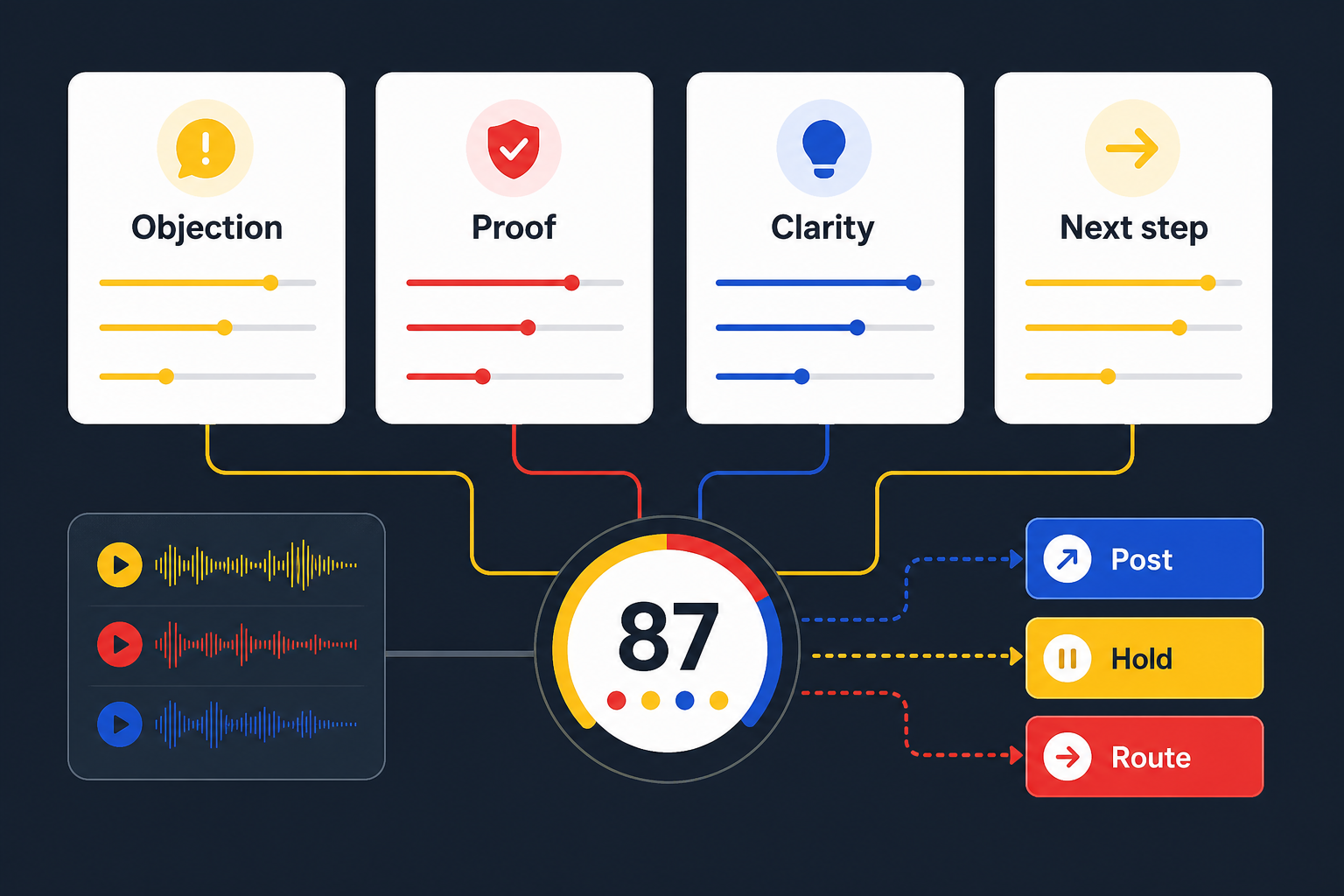
Use this quick filter before you decide what to edit.
Give each moment 0 or 1.
- Does this moment answer an objection buyers actually have?
- Does it show diagnosis, not just advice?
- Does it explain a framework or decision rule in plain English?
- Does it include proof, pattern recognition, or a real operational lesson?
- Does it make your offer easier to understand without turning into a pitch?
- Could a buyer share this with someone else and still have it make sense?
- Does it create a natural next step: full video, blog post, audit, service page, or conversation?
- Would this still be useful in six months?
Score 0-2: keep it in the archive. Maybe useful context, not a priority asset.
Score 3-5: good candidate. Tighten the hook and decide where it should route.
Score 6-8: repurpose this first. Clip it, write from it, and reuse it in more than one place.
This is not fancy.
Good.
The point is to avoid spending half a day polishing a clip that will make strangers nod and then disappear.
If you want a deeper version of this thinking, the article on what to repurpose first from a long-form video archive breaks down source selection before formats.
What To Pull From Different Consultant Recordings
Different recordings hide different kinds of assets.
Do not treat every source the same.
Webinars And Workshops
Webinars are usually the easiest place to start because they already have structure.
You have a promise. You have a teaching arc. You probably have a Q&A section. You may also have a moment where the offer or method becomes clear.
Skip the housekeeping. Nobody needs the “we’ll wait two more minutes” part.
Look for:
- the main framework,
- the mistake you keep seeing,
- the Q&A answer that exposes buyer fear,
- the before-and-after explanation,
- the section where someone would naturally want the deeper workshop.
People still watch webinars months later. And yes, most serious marketing teams repurpose them into other assets now.
So do not just make clips because everyone does it.
Pick the moments that make your consulting feel less abstract.
For a deeper webinar-specific workflow, use the guide on webinar content repurposing.
Podcasts And Interviews
Podcasts are good because you often sound more human there.
Less polished. More alive. You explain things because another person is pulling the idea out of you.
Strong consultant podcast moments usually look like this:
- the host asks a skeptical question,
- you tell the story behind your method,
- you explain a mistake most people make,
- you give a simple decision test,
- the conversation reaches a phrase buyers can remember.
The article on podcast clips that drive leads goes deeper on this, but the short version is simple: clip moments that create buyer trust, not only moments that create attention.
Client Calls And Strategy Sessions
Careful here.
Client calls can be incredibly useful, but privacy comes first. Get permission, anonymize where needed, and do not expose sensitive details.
That said, recorded consulting work often contains your best thinking.
Not because you are performing.
Because you are diagnosing.
You are hearing a messy situation and turning it into a clearer path. That is exactly what future buyers need to believe you can do.
The safest way to repurpose this is often not raw call clips. It might be:
- a written post inspired by a repeated pattern,
- a short “common diagnosis” video recorded fresh,
- a carousel that teaches the framework without naming the client,
- an internal sales asset your team can send after calls.
The insight is valuable. The private details are not public content.
Sales Trainings And Demos
Consultants forget that internal material can be gold.
Sales trainings, onboarding videos, delivery walkthroughs, SOP explainers, and demos often explain your work better than public marketing copy.
You are not trying to impress anybody there. You are trying to make the thing clear.
That clarity is useful.
Pull moments where you explain:
- who is a fit,
- who is not a fit,
- why the method works,
- what happens after someone buys,
- what the client needs to bring,
- where projects usually fail.
These can become sales-page sections, email snippets, short clips, or leave-behind assets.
If you are deciding whether you need production help or strategic selection first, read content repurposing service vs video editor. It will save you from buying polish before you have picked the right source moment.
Founder Videos And POV Recordings
Founders and consultants often record messy thoughts that never become public because they feel unfinished.
Some should stay unfinished.
But some contain the sharpest point of view in the whole archive.
Look for the moment where you say the thing you keep softening in polished copy.
The rough version is sometimes better.
It sounds like a person.
It gives the buyer a sense of how you think when you are not hiding behind perfect brochure language.
Do not over-clean every bit of it. Clean the structure. Keep the human fingerprint.
Where Each Repurposed Moment Should Go
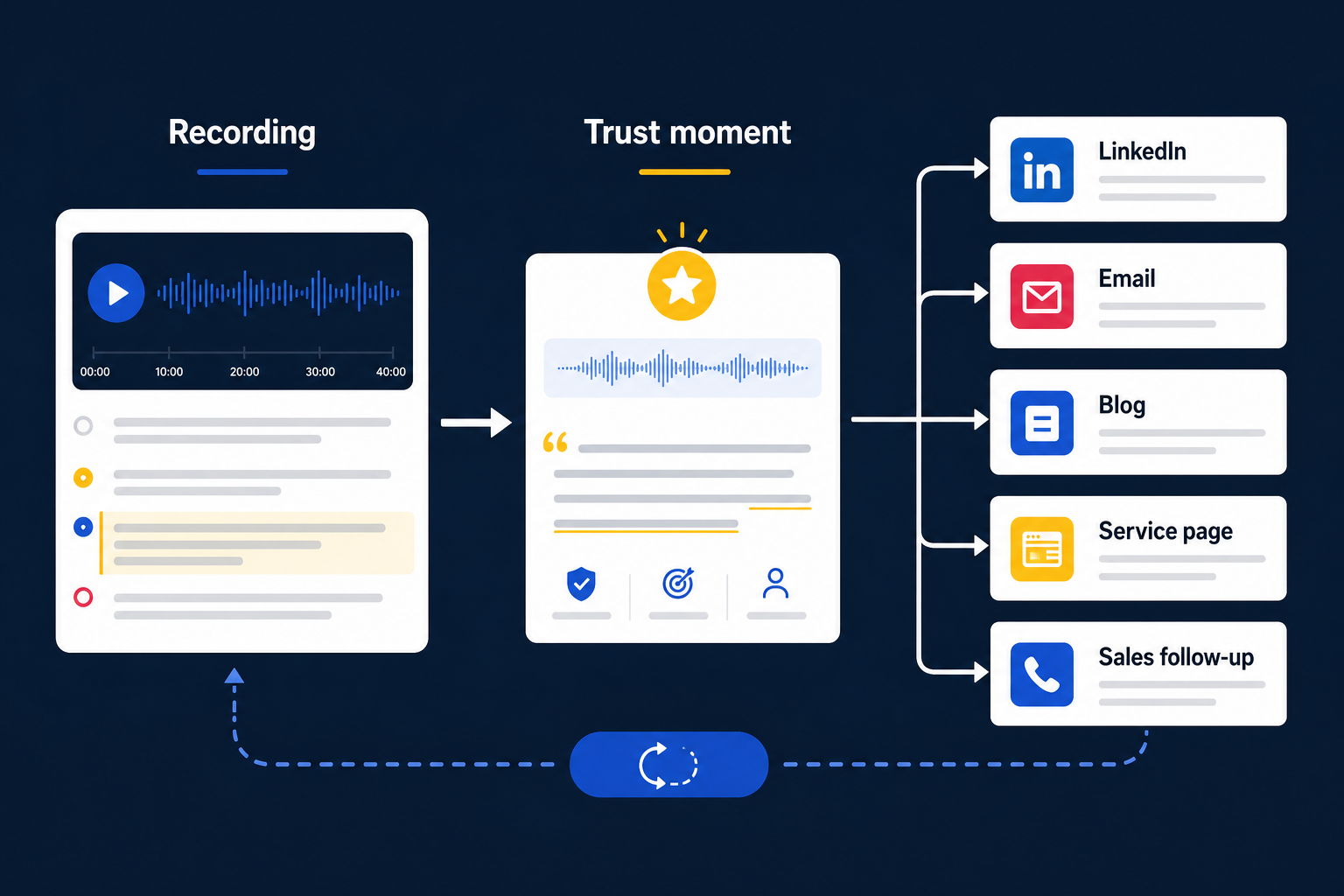
Once you find a strong moment, choose the path.
Do not throw everything onto every platform.
A consultant’s repurposing workflow can stay simple:
- LinkedIn clip: use when the moment is understandable fast and opens a conversation.
- Text post: use when the spoken idea is strong but the video has weak visuals.
- Carousel: use when the idea has steps, questions, or a decision test.
- Blog section: use when the moment answers a search-led question in detail.
- Email: use when the idea helps nurture people who already know you.
- Service page: use when the moment handles an objection or clarifies fit.
- Sales follow-up: use when the moment helps a buyer explain the idea internally.
This is where many teams leak value.
They post the clip once. It does fine. Then it dies.
But a strong consultant moment should travel.
One objection answer can become a clip, a LinkedIn post, a section inside a blog article, a follow-up email after a discovery call, and a small proof block on a service page.
Same thinking. Different job.
That is the difference between random posting and a content repurposing workflow.
If you want the more tactical version, the guide on how to turn 1 video into a week of content shows the format side. Just do the source-moment selection first.
The Post-Watch Gap
Someone watches your clip.
They like it.
They agree.
They scroll away.
Gone.
For consultants, this is painful because the clip may have done the hard part. It made someone feel understood. It created a tiny bit of trust. Then there was no next step.
So give the viewer somewhere useful to go.
It does not always have to be a hard CTA.
It can be:
- watch the full webinar,
- read the deeper article,
- use the free diagnostic,
- see the service fit page,
- download the framework,
- book a call if they are already serious.
Current video research says the same thing in more polished words: social videos get attention, and website videos can drive action. Makes sense. Social is good for discovery. Your site, email, and service pages are better for next steps.
So think in routes.
Where should this moment send the right person next?
A Clip Opportunity Map helps with exactly this. It looks at your long videos and gives you ideas for which moments are worth clipping, why they matter, and how they could warm up the right people before they ever land on your offer.
A Simple Weekly Repurposing Rhythm For Consultants
You do not need a giant media machine.
Start smaller.
Each week:
- Pick one long-form source: webinar, podcast, workshop, demo, or call-safe teaching session.
- Find three buyer-relevant moments with the scorecard.
- Choose one primary moment to repurpose first.
- Turn it into one clip or text post.
- Turn the same idea into one deeper asset: email, blog section, carousel, or sales follow-up.
- Add one clear next step.
- Save the lesson: what got replies, clicks, saves, or better sales conversations?
That is enough to start.
A consultant does not need to become a full-time creator. You need a repeatable way to turn real expertise into assets that warm up the right people.
If you already have a lot of recordings and want help choosing what deserves to exist first, that is where a content repurposing service can make sense.
But even then, do not buy volume blindly.
Find someone who actually knows what to pick, not just how to edit.
What To Do Next
Open one recording.
Not your whole archive. One.
Pick a webinar, podcast, workshop, or video where you know the thinking was useful.
Find one moment that answers an objection, explains your method, or makes your offer easier to understand.
Then ask:
Would this help the right buyer trust us faster?
If yes, repurpose that first.
If you want another pair of eyes on it, run the free Clip Opportunity Map. It helps you see which moments are worth turning into clips, posts, and sales assets before you spend time editing.
Yummy side-effect: you may realize you already have more useful content than you thought.