
Table of contents
You finish a good sales call and think: “We should turn this into content.”
Fair.
There was a buyer on the call. They said the thing your landing page keeps dancing around. They asked why the setup takes so long. They worried their team wouldn’t use the tool. They compared you to the messy spreadsheet workflow they already hate. They said the quiet part out loud.
That is useful material.
Then the team opens the recording, finds a 52-second bit where the founder sounds smart, adds captions, posts it, and moves on.
Nice little clip.
Also probably a missed chance.
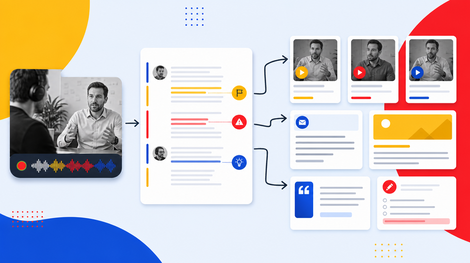
The better move is to start with the buyer’s question, not the founder’s best sentence. That one question can become a LinkedIn post, a short clip, a sales email, a blog section, a proof block, and an internal note for the next call.
One real objection. Several useful assets.
That’s the whole game here.
Sales Calls Have Better Raw Material Than Most Content Calendars
Most content calendars start clean. Too clean.
“Let’s post about onboarding.”
“Let’s make something about pricing.”
“Let’s do a clip about AI workflows.”
Fine topics. Also very easy to make generic.
Sales calls are messier, which is exactly why they’re valuable. A real buyer brings language you wouldn’t invent in a planning doc. They bring pressure. They bring the reason they haven’t bought yet.
Listen for lines like:
- “I’m worried this will slow my team down for the first month.”
- “How is this different from hiring an editor?”
- “We’ve tried tools like this before and nobody used them.”
- “Will this still work if we only publish once a week?”
- “I get the clips part, but how does this help us get leads?”
Those aren’t cute content prompts. They are buying signals.
If three prospects ask the same version of a question, you don’t need a brainstorming session. You have a content brief sitting in your call recordings.
Google’s helpful content guidance is useful here too. Helpful content should serve a real audience, show experience, and give people something useful. A call objection does that naturally because it came from a real person trying to make a decision.
Mine Objections Before You Choose Formats
The normal repurposing order goes like this:
Recording first. Clip second. Caption third. Calendar fourth.
That order creates a lot of “here’s what I think about X” content.
Sometimes that works. Often it just floats past the buyer because it wasn’t built around a question they care about.
Try this order instead:
- Find the buyer objection.
- Capture the exact phrase.
- Pull your best answer.
- Decide who else needs to hear it.
- Choose the format.
- Link it to a useful next step.
This is close to the way we think about a broader content repurposing plan. Formats come after the source moment earns its place.
The question is simple:
Would a real buyer care about this before they book, buy, or trust you?
If yes, keep going.
If no, leave it inside the call notes. No need to force every decent sentence into public.
A Simple Objection-Mining Workflow
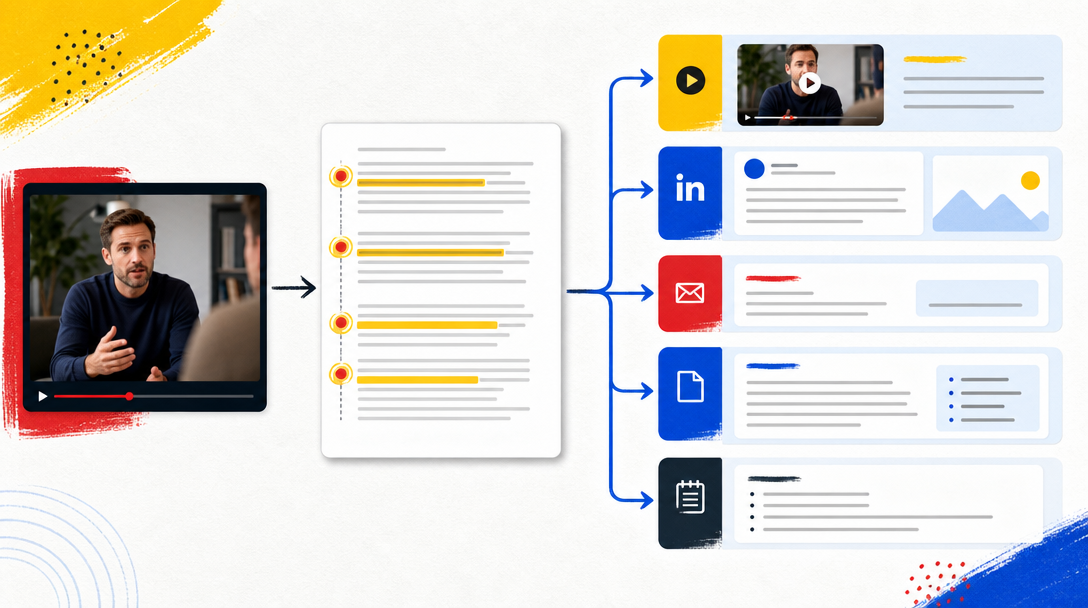
Here’s the workflow I would use on a Tuesday if I wanted to get useful content from one call without turning it into a whole operations project.
Start with one recording. Not ten. One good sales call, demo, coaching call, webinar Q&A, or founder video where a real buyer question showed up.
1. Mark the buyer question
Scan the transcript first. Don’t start by watching the whole video like a tiny cinema night for your own sales calls.
Look for moments where the buyer:
- pushed back
- compared you to an alternative
- named a risk
- explained what failed before
- asked “how does this work if…”
- used language that sounded painfully specific
Copy the exact line. Keep the buyer’s words messy if they are clear. That’s often the good part.
2. Pull your answer
Now grab the answer around it. Trim filler, but don’t sand off every human edge.
If your answer was weak, good. You found a content gap and a sales gap at the same time. Write the answer you wish you had given, then use that for the asset.
That is one reason this workflow is useful beyond marketing. It makes your sales thinking sharper.
3. Score the moment
Use a quick 0 to 2 score:
- Buyer frequency: have you heard this more than once?
- Decision weight: could this block someone from buying?
- Search fit: would someone type a version of it into Google?
- Trust value: does your answer show experience, proof, or clear judgment?
- Reuse range: can it become more than one asset?
Eight to ten is worth attention.
Five to seven is maybe.
Under five usually stays internal.
When in doubt, ask this: would I send this to a prospect before their demo?
If yes, it can probably become content. If no, it might only be admin, context, or nice conversation.
4. Choose the first output
Solo founder version:
Start with a written post. It’s fastest and forces clarity.
Then make a clip if the moment has good delivery on video.
Then turn the answer into an email or sales note.
Then, if it keeps coming up, expand it into a blog section or full article.
You don’t have to make five things every time. Start with the asset that helps the buyer fastest.
5. Package with a next step
This is where a lot of good clips die.
Someone watches, nods, and disappears.
Give the moment somewhere to go:
- full article
- related long-form video
- service page
- free diagnostic
- pricing page
- sales follow-up
- internal call prep note
If the clip answers “will this work for my team?”, the next step might be a deeper article about implementation. If the post answers “how is this different from hiring an editor?”, the next step might be a service page or comparison guide.
That is how you reduce the post-watch gap. The moment doesn’t just get attention. It moves someone to a better next step.
What To Cut And What To Keep
Most sales calls are not public content.
Good. They shouldn’t be.
You are looking for buyer-relevant moments, not a highlight reel of everything said in the room.
Keep moments like:
- pricing objections tied to value
- setup, adoption, or team-disruption concerns
- competitor comparisons
- “we tried this before and it failed” stories
- buyer language that describes the pain better than your website does
- moments where your answer makes the buyer visibly understand something
- questions that keep showing up across calls
Skip moments like:
- generic founder monologues
- company history with no buyer tension
- feature walkthroughs where nobody reacts
- deal-specific negotiation details
- private customer examples without permission
- compliments, small talk, and rapport
- jargon that only current customers understand
Some skipped moments are still useful. They might become internal sales notes, onboarding notes, or product feedback.
They don’t all need to become public.
Very freeing, honestly.
Turn One Objection Into Several Useful Assets
Say a prospect asks:
“I’m worried we’ll get a bunch of clips, but none of them will lead anywhere.”
That is a strong ContentFries-style question because it points straight at business value. It also connects to B2B video content repurposing, where the output should be more than short clips.
From that one objection, you can make:
- A LinkedIn post: “A clip without a next step is just a little interruption.”
- A short clip: the buyer asks the question, then you explain the post-watch gap.
- An email: “Before you make more clips, decide where each one should send people.”
- A blog section: “How to connect repurposed clips to buyer next steps.”
- A sales note: “If prospect worries about views vs leads, show Map workflow and next-step examples.”
- A proof block: “Most teams don’t need more clips first. They need to know which moments deserve a door.”
Same source. Different jobs.
This is where repurposing starts to feel like a system instead of a pile.
It also gives AI better input. Google’s AI content guidance is a decent reminder: automation can help with production, but the content still needs useful, people-first substance. A real buyer objection is better source material than asking AI to invent another “10 tips” post from nothing.
Different Call Types Give You Different Signals
Sales and demo calls
These are usually highest value because money and urgency are already in the room.
Best signals: price, implementation, comparison, trust, timing, internal buy-in.
Common mistake: clipping your demo flow instead of the buyer’s hesitation.
Coaching and consulting calls
These are strong for recurring patterns. Clients often explain their stuck point in a way that other buyers recognize immediately.
Best signals: repeated mistakes, mindset blocks, process breakdowns, language around pain.
Common mistake: sharing too much context from one client instead of turning the pattern into a useful public lesson. The coaching calls into content workflow needs extra care for privacy and permission.
Customer interviews
These are proof-heavy. Great for pages, emails, case studies, and credibility clips.
Best signals: before-state language, why they chose you, what changed, what surprised them.
Common mistake: polishing the customer’s words until they sound like a testimonial widget. The best customer interviews into content keep the human phrasing.
Webinars and live trainings
The Q&A is usually more useful than the presentation.
Best signals: what people ask after they hear the idea, where they get confused, what they need before taking action.
Common mistake: clipping the polished slides and ignoring the live questions.
Founder videos
Founder videos work when they answer questions already heard from buyers.
Best signals: “here are the three objections we keep hearing”, “here’s what people misunderstand”, “here’s when this isn’t a fit.”
Common mistake: riffing on vision and calling it content. Vision can be useful. Buyer questions make it sharper.
Quick Permission And Claim Check
Tiny boring section. Still important.
Before you publish anything from a sales call, check the obvious stuff:
- Did everyone know the call was recorded?
- Do you have permission to use the moment publicly?
- Should the buyer be anonymized?
- Does the clip include private customer, revenue, or team details?
- Does a result claim need context?
- Is there any sponsorship, incentive, or partnership to disclose?
I’m not your lawyer, and call recording rules can depend on where people are. Keep your process boring and careful.
For claims, endorsements, and sponsorships, the FTC disclosure guidance and YouTube paid promotion rules both point in the same practical direction: don’t mislead people about relationships, incentives, or results.
Most teams don’t need legal theater for every post.
They need a small habit:
Safe to publish. Needs approval. Anonymize. Internal only. Skip.
That little checklist saves pain.
Where ContentFries Fits
ContentFries is built for this source-first way of thinking.
The free Clip Opportunity Map looks at long-form videos and helps find the moments worth repurposing first. Not every moment gets treated like gold. Some moments become clips. Some become article sections. Some become proof blocks. Some become internal notes. Some get skipped.
That decision matters before editing starts.
If you already know your calls, demos, podcasts, or webinars hold useful buyer moments and you want help turning them into a repeatable system, the content repurposing services page is the more direct path.
If you’re still wondering what is worth pulling from your archive, start with the Map.
You can check a few videos and see which moments actually deserve work.
Much better than making another random clip because Thursday needed a post.
Sources
- Google Search Central: Creating helpful, reliable, people-first content
- Google Search Central: Video SEO best practices
- Google Search Central: Guidance on using generative AI content
- FTC: Disclosures 101 for Social Media Influencers
- YouTube Help: Add paid product placements, sponsorships and endorsements