
Table of contents
You know the drill.
You record the episode. Maybe it is a solo podcast. Maybe a founder interview. Maybe a webinar that later becomes a podcast feed episode.
You prepare, explain, give away the good thinking, tell a few stories, answer the real questions.
Then someone says, “You should clip this.”
So you do.
You pull the punchy moment. The funny moment. The part where the guest says something spicy. The line that feels most likely to get views.
And sometimes it works.
The clip gets attention. People watch. Maybe someone comments “great point”.
Then… nothing.
No useful reply. No click. No booked call. No person saying, “I saw your clip and I think this is exactly what we need.”
That is the annoying part.
For expert-led businesses, proving you can get attention isn’t enough. You need the right person to trust you faster.
Short answer: the best podcast clip is usually the moment that answers a buyer objection, proves your thinking, or makes the full episode worth watching. Not always the loudest moment.
Let’s make this practical.
Views Are Useful, But Incomplete
Views are not evil.
Please don’t become the person who pretends views mean nothing. If nobody sees the clip, it cannot warm anybody up.
But views are a weak scoreboard by themselves.
If you sell coaching, consulting, services, expert training, or B2B software, the clip has to do more than entertain a stranger for 42 seconds.
It has to make the right person think:
- “Ok, they understand my problem.”
- “This is the kind of thinking I need.”
- “Maybe the full episode is worth my time.”
- “Maybe I should look at what they do.”
Look at any serious marketing report right now and you will see the same tension. Everyone tracks views, but everyone wants qualified leads.
So yes, views matter.
Useful views matter more.
A clip that gets 800 views from the right buyers can beat a clip that gets 80,000 views from freebie seekers, students, and random scrollers.
That sounds obvious.
But most clip selection still starts with “what will pop?”
Better question: “What would make the right buyer trust us faster?”
What Happens After The Clip
Here is where many podcast clips quietly fail.
The clip ends, and the viewer has no useful next move.
They liked it.
They nodded.
They scrolled.
Gone.
No door opened. No path back to the full episode. No tiny action. No reason to identify themselves. No reason to remember you tomorrow.
This is very normal because most clips are built like tiny entertainment assets. Hook, insight, finish.
Nice.
But a lead-driving clip needs a job after the insight lands.
It can send someone to the full episode because the clip showed one piece of a deeper framework.
It can make them check their own business for a leak.
It can push them toward a useful free tool.
It can make a sales page feel less abstract because they saw the founder explain the thinking in plain English.
Wistia recently made a useful distinction: social video gets attention, while website video can drive action.
Simple point.
Where the clip lives and what it asks the viewer to do changes the business outcome.
A podcast clip on LinkedIn can create discovery.
The same clip inside a blog post can build trust.
The same clip on a service page can handle an objection.
Same source. Different job.
Five Podcast Moments Worth Clipping First
When you open an episode, don’t start with “what sounds viral?”
Start with the buyer.
These five moments are usually worth checking first.
1. The Objection Moment
This is where you answer the doubt that blocks a sale.
For a consultant, it might be why the client should fix the process before hiring.
For a coach, it might be why their audience keeps collecting advice but not changing behavior.
For a B2B founder, it might be why onboarding fails before users ever see the value.
These moments make strong clips because they meet the buyer inside their hesitation.
2. The Proof Moment
Proof does not always mean polished case study.
Sometimes proof is a before-and-after story.
Sometimes it is a lesson from delivery.
Sometimes it is the way you diagnose a messy situation in 60 seconds.
If the moment makes your method feel real, clip it.
3. The Framework Moment
People remember useful structure.
A three-step method. A decision test. A scoring question. A way of naming the messy thing they already feel.
This is where podcast repurposing can become more than highlight cutting.
Don’t just look for a clean quote.
Find a reusable idea.
4. The Full-Episode Door
Some clips should make the full episode more valuable.
They give one useful piece, then make the viewer want the rest.
Not fake cliffhanger. Not “watch until the end”.
Just enough depth that the viewer thinks, “Ok, if this is the clip, the full conversation may be worth it.”
5. The Offer-Clarity Moment
Sometimes your best clip is the part where your work finally makes sense.
Not the pitch.
The moment where someone understands who you help, what you fix, and why the old way keeps costing them.
These moments can feel too obvious to you.
To a buyer, they can be the bridge.
Quick Clip Filter
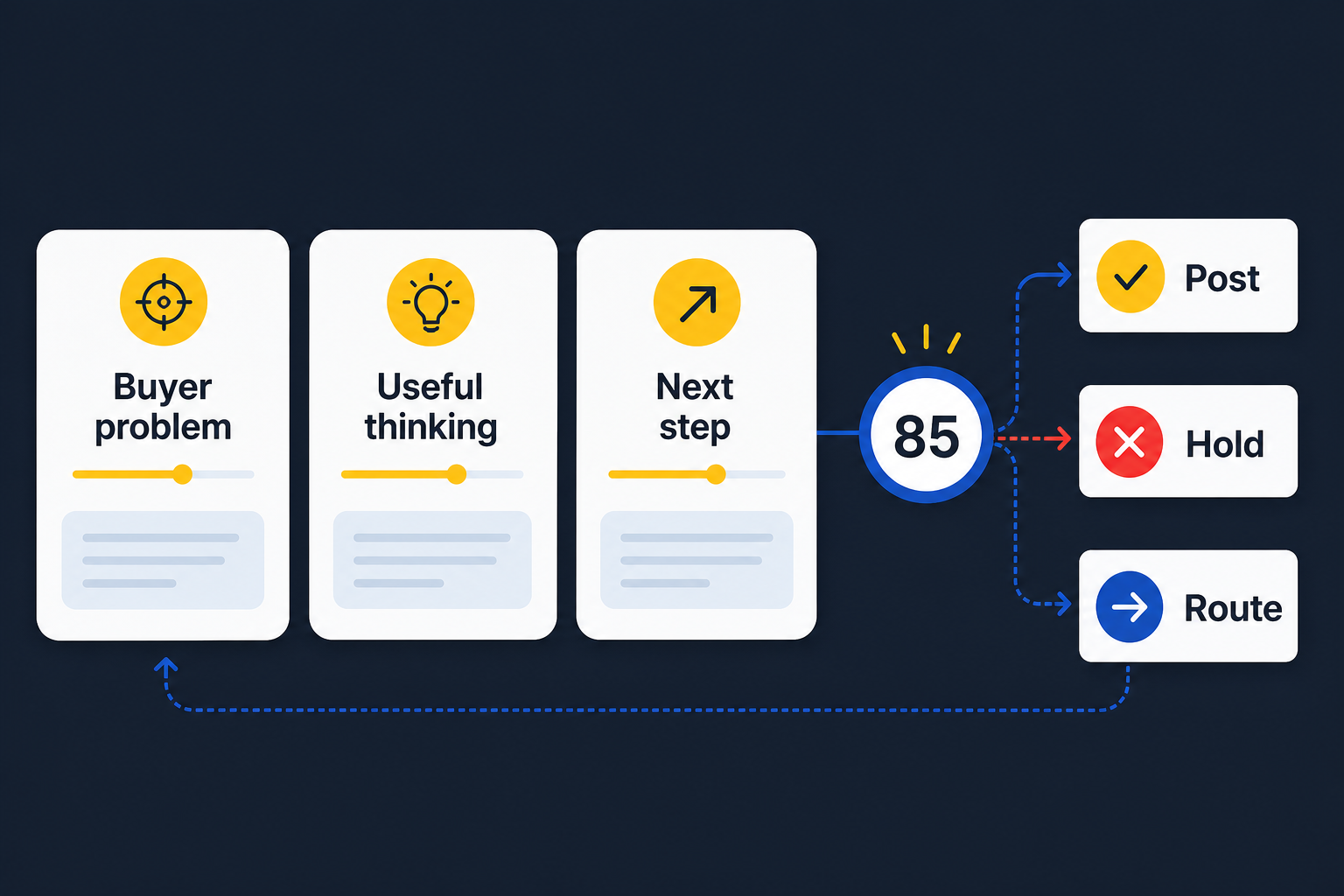
Before you post a podcast clip, score it quickly.
Give each question 0 or 1.
- Would my specific buyer recognize their own problem in this clip?
- Does it show thinking they could not get from a generic search result?
- Does it answer an objection, prove expertise, or clarify the offer?
- Does it make the full episode, tool, service page, or next step feel natural?
- Is the value clear in the first few seconds without clickbait?
- Would this still be useful six months from now?
- Does it survive without the full episode context?
Score 0-2: probably weak for business. Maybe entertaining, but not lead-ready.
Score 3-4: useful candidate. Strengthen the hook or next step.
Score 5-7: strong. This is probably worth editing, captioning, and routing properly.
This is the boring little filter most teams skip.
And yes, it will kill some clips that feel fun.
Good.
Some clips deserve to stay inside the episode.
How To Frame Clips For Buyers
Once you find the right moment, the frame decides whether it lands.
A buyer clip needs a sharper setup than a generic highlight.
Start with the specific person.
Weak:
- “Here’s a great marketing tip.”
Better:
- “If your podcast gets downloads but no sales conversations, check this.”
Weak:
- “This founder had an interesting take.”
Better:
- “A simple reason expert podcasts get views but no buyer signal.”
Weak:
- “You need better content.”
Better:
- “Your best sales answer might already be buried inside episode 23.”
Narrow hooks usually lose some casual viewers. That is fine. Casual viewers were never the prize.
Give real value inside the clip. Do not make everything a tease.
If the clip is about pricing, give one useful pricing thought.
If it is about onboarding, give one useful onboarding mistake.
If it is about content strategy, give one useful decision rule.
Then make the next step small.
“Watch the full episode” is often too vague.
“Full episode breaks down the three-part framework” is better.
“Run this check on your own archive” is better.
“Use the free Clip Opportunity Map if you want help finding these moments” is better when the clip is clearly about source selection.
The next step should feel like a continuation, not a pitch pasted at the end.
Where Podcast Clips Should Go
Do not treat every platform like the same room.
LinkedIn is the obvious B2B starting point for many expert-led businesses.
But LinkedIn is not the only place a clip can work.
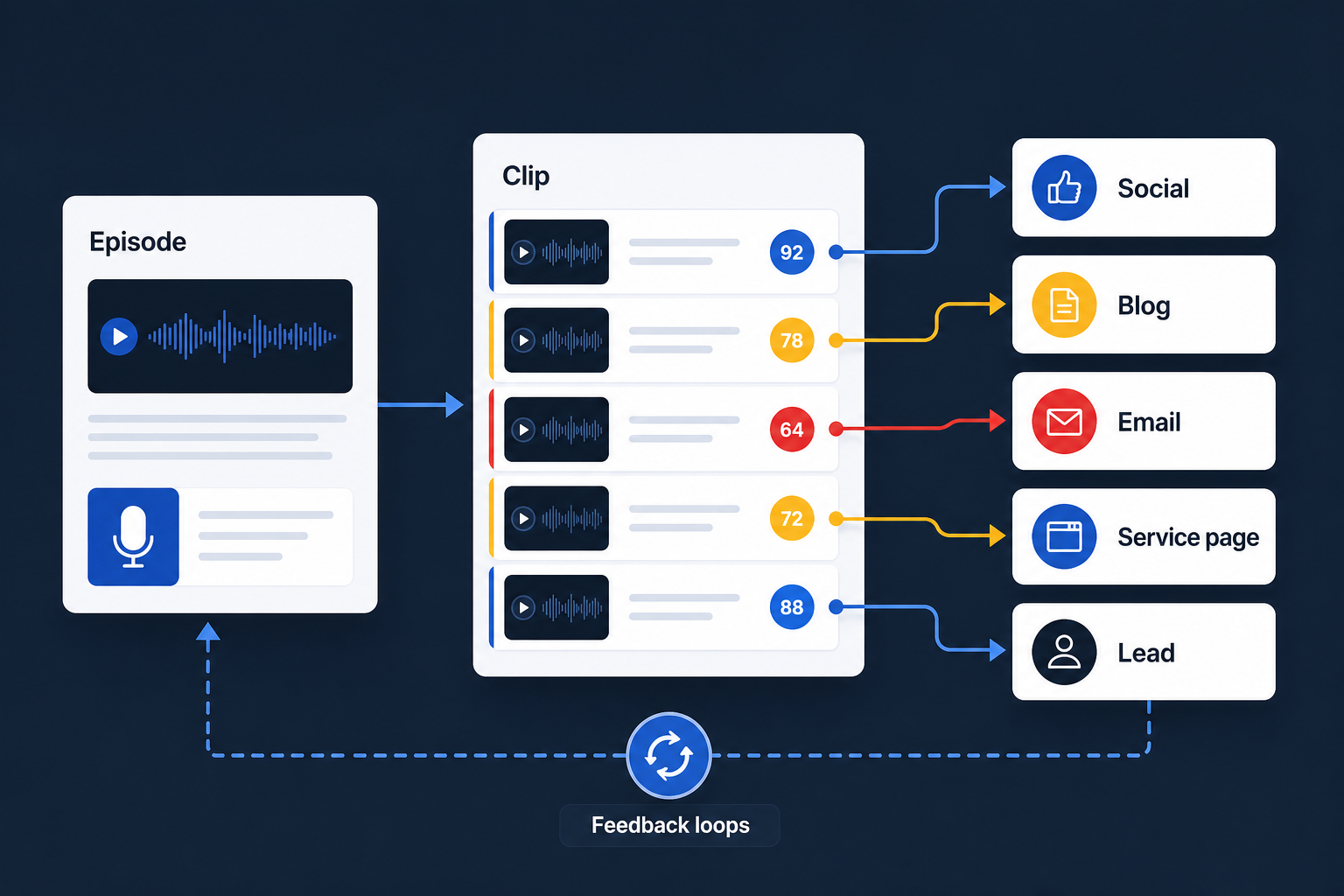
Use different routes for different jobs:
- Social feed: discovery and trust spark.
- Blog post: proof and explanation beside the written idea.
- Service page: objection handling and offer clarity.
- Email: fast explanation for people already warm.
- Full episode page: chapter preview and reason to keep watching.
This is why a content repurposing workflow should start before editing.
If the clip is meant for LinkedIn, the first three seconds matter a lot.
If it is meant for a service page, clarity matters more than drama.
If it is meant for email, the setup text may do half the work.
Same clip, different wrapper.
That wrapper can decide whether the clip becomes useful or just floats around.
Do Not Let AI Pick Only The Loudest Moment
AI tools can help.
They can scan transcripts. Find high-energy moments. Mark laughter. Suggest hooks. Build caption drafts. Good.
Use them.
But don’t outsource the business decision.
AI can spot a highlight. It may not know your buyer.
It may not know that the quiet answer at minute 31 is the one you repeat on every sales call.
It may not know that the funny guest story will attract a big audience and zero fit.
Same-template clip volume feels cheap fast.
Buyers can smell it.
Use AI to surface candidates. Use human judgment to decide which moments deserve distribution.
If you work with a video editor or repurposing partner, give them business criteria alongside timestamps.
Ask for moments that answer objections, prove expertise, clarify the offer, or create a natural next step.
“Find highlights” gives you highlights.
“Find buyer-trust moments” gives you a much better starting point.
One Episode Can Feed A Week
A strong podcast episode can usually produce more than one useful clip.
Not twenty.
Please, not twenty unless the episode is unusually rich.
But three to seven strong moments from one long-form recording is realistic.
One objection clip.
One framework clip.
One story clip.
One full-episode door.
One offer-clarity clip.
Now the episode has a job across the week.
One clip goes to LinkedIn.
One becomes part of a blog section.
One goes into the newsletter.
One gets saved for a service page or follow-up email.
This is how you turn one video into a week of content without making seven random assets.
You are not squeezing content for the sake of volume.
You are routing useful moments to places where they can help the right person move.
If you are not sure which moments deserve that treatment, start with what to repurpose first. Source selection makes everything after it easier.
A Simple Clip Opportunity Map
Open your last five podcast episodes.
For each one, write down:
- one buyer objection answered,
- one proof moment,
- one framework or decision rule,
- one moment that makes the full episode worth watching,
- one moment that explains your offer or method.
That is already a small Clip Opportunity Map.
You will quickly see the pattern.
Maybe you have lots of education clips and no proof.
Maybe you have many hot takes and almost no next step.
Maybe your best buyer answers are buried in Q&A, not in the main interview.
Maybe the same objection comes up again and again, which means it deserves a stronger public clip.
ContentFries has a free Business Content Audit for this exact reason. It looks at your long-form source material and helps flag which moments are most worth repurposing first.
Not every moment deserves editing.
Some should stay buried.
Some should become clips.
Some should become blog sections, email answers, or sales-page proof.
The win is knowing which is which before you spend the editing time.
Bottom Line
Podcast clips can drive leads.
But only when they are chosen like business assets, not random highlights.
Pick moments that help buyers trust you faster.
Frame them so the right person recognizes themselves.
Route them somewhere useful after the watch.
Do that consistently and clips stop being little visibility snacks.
They become small doors back into your thinking, your offer, and the longer trust-building content you already made.
Nice little machine.