
Table of contents
1. You Get More Value From Work You Already Did
2. You Can Produce Useful Content Faster
3. Your Expert Voice Shows Up In More Places
4. Buyers Can Discover The Same Idea In The Format They Prefer
5. Your Content Can Support Real Sales Conversations
6. You Learn What Buyers Care About
7. Your Content Library Compounds
You already recorded the webinar. The founder explained the idea properly on a podcast. Your consultant answered the hard question on a sales call. The product demo finally made the use case click.
Then everybody moved on, even though that recording still has work left in it.
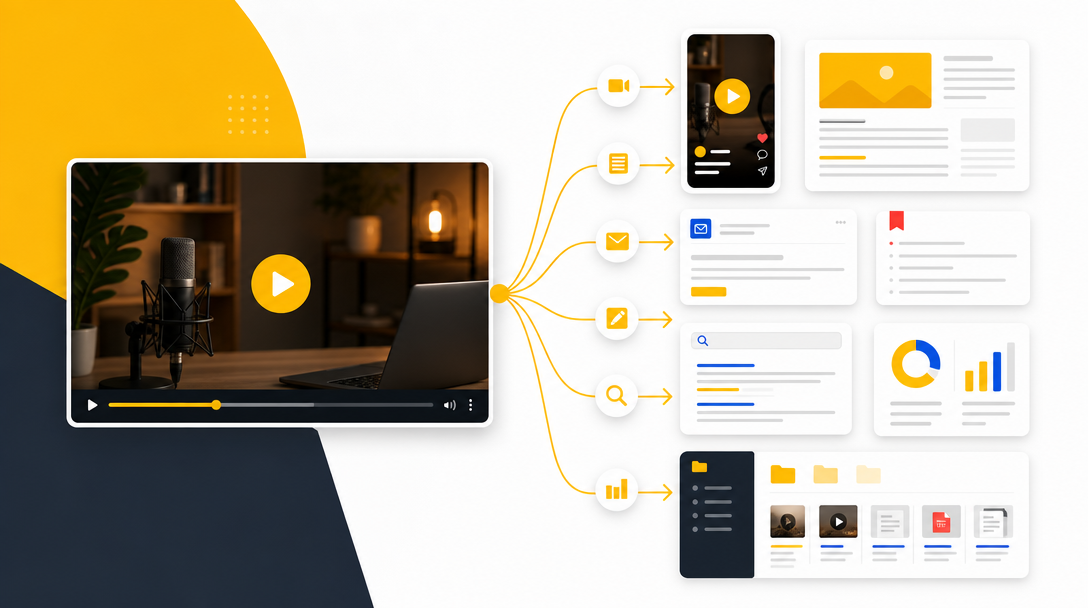
Content repurposing means taking useful source material and rebuilding it for another job, format, or channel. A webinar can become a short clip, an article, a sales email, a carousel, a proof block, or a useful follow-up after a call.
The business benefit goes much further than publishing more often.
Good repurposing helps a small team get more value from expertise it already paid to create. It can make the expert easier to trust, help buyers find answers in more places, and give sales better material for real conversations.
There is a catch: you only get those benefits when the source is useful and each new asset has a job. Cutting one video into twenty random clips gives you twenty files. A content engine needs more thought than that.
Here are the seven benefits that matter most for an expert-led business.
1. You Get More Value From Work You Already Did
Recording good long-form content takes time.
Somebody prepares the topic. The expert records. A team member edits the session, uploads it, writes the page, sends the email, and handles the follow-up.
Using that recording once is expensive.
Repurposing spreads the original effort across more useful assets. One 45-minute webinar might contain:
- one clear explanation for a searched question,
- three short moments that stand alone,
- two buyer objections worth answering,
- one useful framework for a carousel,
- a follow-up email for people who missed the event,
- a product or service page section,
- several internal notes for sales.
This works because the expensive part already happened. The expert formed the idea and explained it in context.
Your next job is to find the moments with another useful life.
Wistia’s 2026 video research found that 88% of teams repurpose webinar content, while 60% pull social clips from webinars. On-demand sessions can keep getting views for months after the live date. Teams are finally treating the original recording like an asset with a shelf life.
Start with what to repurpose first from your long-form archive. The best starting recording usually has a clear buyer, repeated questions, and a topic connected to the offer.
2. You Can Produce Useful Content Faster
Blank-page content is slow.
Every post needs a topic. Every clip needs a point. Every article needs examples. When the team invents all of that from scratch, the content calendar becomes a weekly argument with an empty document.
Source material removes a lot of that friction.
The transcript already contains ideas, phrases, questions, examples, and rough structure. A sales call contains buyer language. A demo contains a real use case. A webinar Q&A contains the questions people cared enough to ask.
You still have to make decisions, but repurposing gives your judgment something real to work with.
That matters even more as AI enters the workflow. Wistia reports that 62% of teams either use AI in video work or plan to start soon. AI can search transcripts, group themes, propose clips, and reshape a spoken explanation. The output gets much better when you give it a real source plus a clear buyer and job.
If you’re using AI, give it the inputs a content repurposing system actually needs. A transcript alone is rarely enough.
3. Your Expert Voice Shows Up In More Places
Expert-led businesses have one thing going for them. Someone inside actually knows the work.
That expertise often gets trapped in a few places. Calls. Workshops. Long YouTube videos. Internal Looms. Podcast episodes that only regular listeners hear.
Repurposing carries the expert’s judgment into formats buyers can find and use.
A spoken answer can become:
- a clip for the person scrolling LinkedIn,
- a search page for the person asking Google,
- an email for the lead who isn’t ready to book,
- a sales asset for the champion explaining the idea internally,
- a short post for the buyer who will never watch a 50-minute recording.
The useful part is the expert’s judgment. Keep it.
LinkedIn’s B2B research says almost three in four decision-makers find thought leadership more trustworthy for assessing a company’s capability than product sheets or standard marketing material. Its 2025 research also found that 95% of hidden buyers become more open to outreach after strong thought leadership.
Choose carefully. Look for moments where the expert explains a tradeoff, names a repeated pattern, answers a hard objection, or shows why a common shortcut fails. Those moments carry judgment. Generic tips carry less.
4. Buyers Can Discover The Same Idea In The Format They Prefer
People don’t all consume expertise the same way.
One buyer searches for a guide. Another watches a clip during lunch. Another saves a carousel. A warm lead wants the full webinar. A sales prospect needs a two-minute answer they can send to a colleague.
Repurposing gives one useful idea several doors.
Avoid blindly posting the exact same file everywhere. Each channel still needs a version that fits how people use it.
For example, a webinar answer about choosing podcast clips could become:
- a 45-second clip with one clean point,
- a LinkedIn post built around the tradeoff,
- an article section with steps and examples,
- a sales email answering the original objection,
- a short checklist for a client team.
Same source idea. Different job and wrapper.
This matters for newer discovery habits too. A 2026 Ascend2 and TopRank study found that 32% of professionals now discover thought leadership through generative AI tools. Search pages, clear explanations, original examples, and connected topic clusters help your expertise appear outside the social feed.
A simple content repurposing plan keeps these versions connected instead of creating five isolated content piles.
5. Your Content Can Support Real Sales Conversations
Your most valuable repurposed assets might never get huge reach. Their job is to help one specific buyer move forward.
Think about the explanations your sales team repeats:
- how your process works,
- who gets the best result,
- what setup requires,
- why the cheap option falls short,
- what happens after the first month,
- how the offer fits an existing team,
- what a realistic result looks like.
Those answers often exist inside calls, demos, workshops, and founder recordings.
Turn them into small, clear follow-up assets. A two-minute clip after a sales call can be more useful than a public post with 20,000 views. An article answering one buying doubt can work in search, nurture, onboarding, and sales follow-up.
LinkedIn reports that creator perspectives help roughly two-thirds of B2B buyers evaluate options during consideration. Nearly half visit a vendor website after engaging with creator content, and more than one-third say it prompted them to talk to sales.
The path still needs design. A viewer who likes a clip and finds nowhere useful to go stays anonymous.
That is why you should connect content to the next buyer step and fix the post-watch gap.
6. You Learn What Buyers Care About
Repurposing creates a feedback loop when you track the right things.
One long recording gives you several moments to test. You can learn which questions earn saves, which explanations bring search visits, which clips hold attention, which emails get replies, and which assets sales keeps sending.
That tells you more than whether the original video got views.
Suppose a podcast episode covers five ideas. The full episode performs fine. Then one repurposed clip about a specific pricing objection keeps getting qualified comments and sales replies.
That signal can shape:
- the next long-form recording,
- the next article,
- a product page update,
- a sales script,
- the way you describe the offer,
- which topic deserves a deeper workshop.
Repurposing lets the market vote on smaller pieces of the expert’s thinking.
Most teams skip measurement. Wistia found that less than half of marketers connect their video platform to a CRM or email tool. The 2026 Ascend2 research says 41% cite measurement difficulty as the main cause of underperforming content.
You don’t need a huge attribution model on day one. Track what the asset was supposed to do. A discovery clip needs qualified views and profile visits. A sales email needs replies. A buyer guide needs useful CTA clicks and booked conversations. Match the metric to the job.
7. Your Content Library Compounds
A useful archive gets stronger as pieces connect.
One webinar becomes clips and an article. That article links to a deeper guide. A later sales call adds a better example. A customer interview gives you proof. A product demo answers the implementation question. Together, those assets make the topic easier to understand and trust.
This compounding effect helps small teams compete without trying to out-publish giant media operations.
You can build topic depth around the things your buyers actually need:
- the painful situation,
- the available options,
- the tradeoffs,
- the process,
- the objections,
- the proof,
- the next step.
Each new source can strengthen something that already exists.
That makes your archive useful for search, sales, and the buyer who finds you through an AI tool. It also reduces the pressure to chase a brand-new topic every week.
The library only compounds if someone keeps it organized. Use clear topics, stable URLs, internal links, source notes, and an owner who can decide whether an old asset needs a refresh, a new wrapper, or retirement.
When Content Repurposing Doesn’t Help
Repurposing multiplies what is already there.
Weak source material usually creates more weak material.
Slow down when:
- the recording has no clear audience,
- the expert says nothing specific,
- the source is outdated,
- the buyer context is missing,
- every clip needs a paragraph of setup,
- private calls contain details you cannot safely use,
- the team has no next step for interested viewers,
- nobody owns distribution or learning.
If several of those sound familiar, start with the common content repurposing problems and practical fixes before you scale the workflow.
Sometimes the right decision is to record a better source.
Sometimes the useful moment belongs in a sales note instead of a public post.
Sometimes an old article needs a refresh before you send more traffic to it.
Good repurposing includes the decision to leave weak material alone.
A Simple Way To Start
Pick one recording. A recent webinar, founder video, podcast, demo, or sales call with permission-safe material.
Then do this:
- Name the buyer and the job.
- Mark five moments with clear questions, tradeoffs, examples, or objections.
- Score each moment for buyer relevance, clarity, trust value, reuse range, and next-step fit.
- Choose the best two moments.
- Build one discovery asset and one sales-support asset.
- Connect both to a useful next step.
- Review the signal before making ten more.
That’s enough to learn from before you scale it.
If you have a long-form archive and want help turning it into useful buyer content, create a free ContentFries account.
Submit your YouTube channel during onboarding. ContentFries can map the useful moments, buyer questions, and next content paths hiding inside it.