
Table of contents
A founder video can do more than keep LinkedIn warm.
It can explain the weird thing your buyers keep misunderstanding.
It can show how you think.
It can answer the question your sales calls keep circling.
It can give your team better words for the offer.
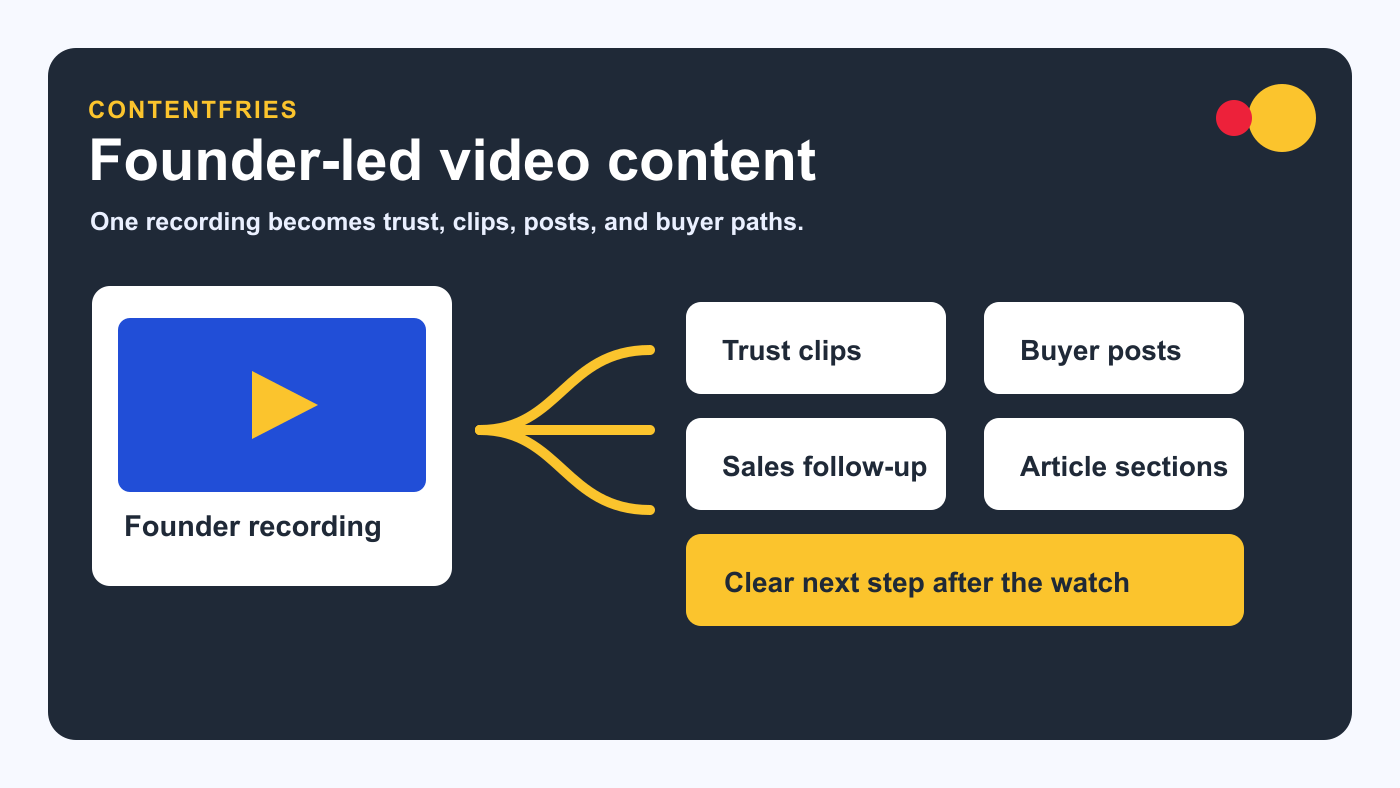
And yes, it can become clips, posts, emails, article sections, proof blocks, and sales follow-up.
But only if you treat the recording as source material first.
Founder-led content gets messy when teams start with the format. “We need three clips.” “We need a LinkedIn post.” “We need something for Tuesday.”
Fine. Calendars exist. Somebody has to feed them.
But the useful part is usually one layer deeper: what did the founder say that helps the right buyer trust the business faster?
That is the part to mine.
2026 B2B video data backs this. Wistia says LinkedIn is now B2B’s top video-sharing channel, and more than half of companies repurpose video into social clips. LinkedIn’s own 2026 research says credibility is beating polished brand messaging, and credible expert voices matter in buying decisions.
So the opportunity is real.
The trap is also real.
Founder-led content can either become a trust asset, or it can become another pile of vague posts that sound like every other “lessons from building” thread.
You want the first one.
Why Founder-Led Video Works
Founder-led video is useful because buyers get the thing most brand content removes.
They get your actual judgment, not just information.
The founder explains why a tradeoff matters. Why a common shortcut fails. Why the buyer keeps getting stuck. Why the product or service works the way it does. Why the team says no to some customers. Why a result is possible for one type of business and unrealistic for another.
That is hard to fake with generic content.
It is also hard to capture if the founder only records polished scripts.
The best source recordings are often normal working material:
- founder Looms,
- sales call explanations,
- podcast interviews,
- webinars,
- workshops,
- product walkthroughs,
- customer Q&A sessions,
- internal training,
- teardown recordings,
- founder reactions to market patterns.
Look for clear thinking in motion.
Perfect delivery matters less.
The kind of moment where a buyer thinks, “Ok, they understand this.”
Start With The Buyer Job
Before you clip anything, ask what job the content should do.
Start with the buyer job.
Platform decisions come after that.
For a founder-led business, the useful jobs are usually:
- explain the category,
- name the painful pattern,
- answer a repeated buying doubt,
- show the before and after,
- teach a simple framework,
- make the offer easier to understand,
- help a champion explain the idea internally,
- give a warm lead a next step,
- help a past viewer come back with more intent.
This changes what you pull from the recording.
If the job is awareness, you may want a sharp idea that opens a loop.
If the job is trust, you may want the part where the founder explains a tradeoff honestly.
If the job is sales support, you may want the objection answer that would never win the feed but would help one real buyer decide.
If the job is SEO, you may want the plain explanation that answers a search question and becomes a section in a guide.
Same recording. Different job. Different asset.
That is why a video content repurposing strategy matters before editing. Stop collecting “good bits” and start choosing moments that have a job.
The Founder Moment Score
Use this score before you brief clips or posts.
Give each moment 0, 1, or 2 points for each question:
- Buyer relevance: would a real prospect care?
- Trust value: does this make the founder or team more credible?
- Clarity: can someone understand it without the full recording?
- Specificity: does it avoid vague advice?
- Reuse range: can it become more than one asset?
- Next-step fit: does it naturally point somewhere useful?
Ten to twelve points is a strong public asset.
Seven to nine points can become a post, email, or article section with a wrapper.
Under seven might still be useful internally, but it probably does not deserve a full edit.
This scoring keeps you from clipping every confident sentence.
Very important.
Founders say many things with conviction. Not all of them are content.
A Simple Founder-Led Video Workflow
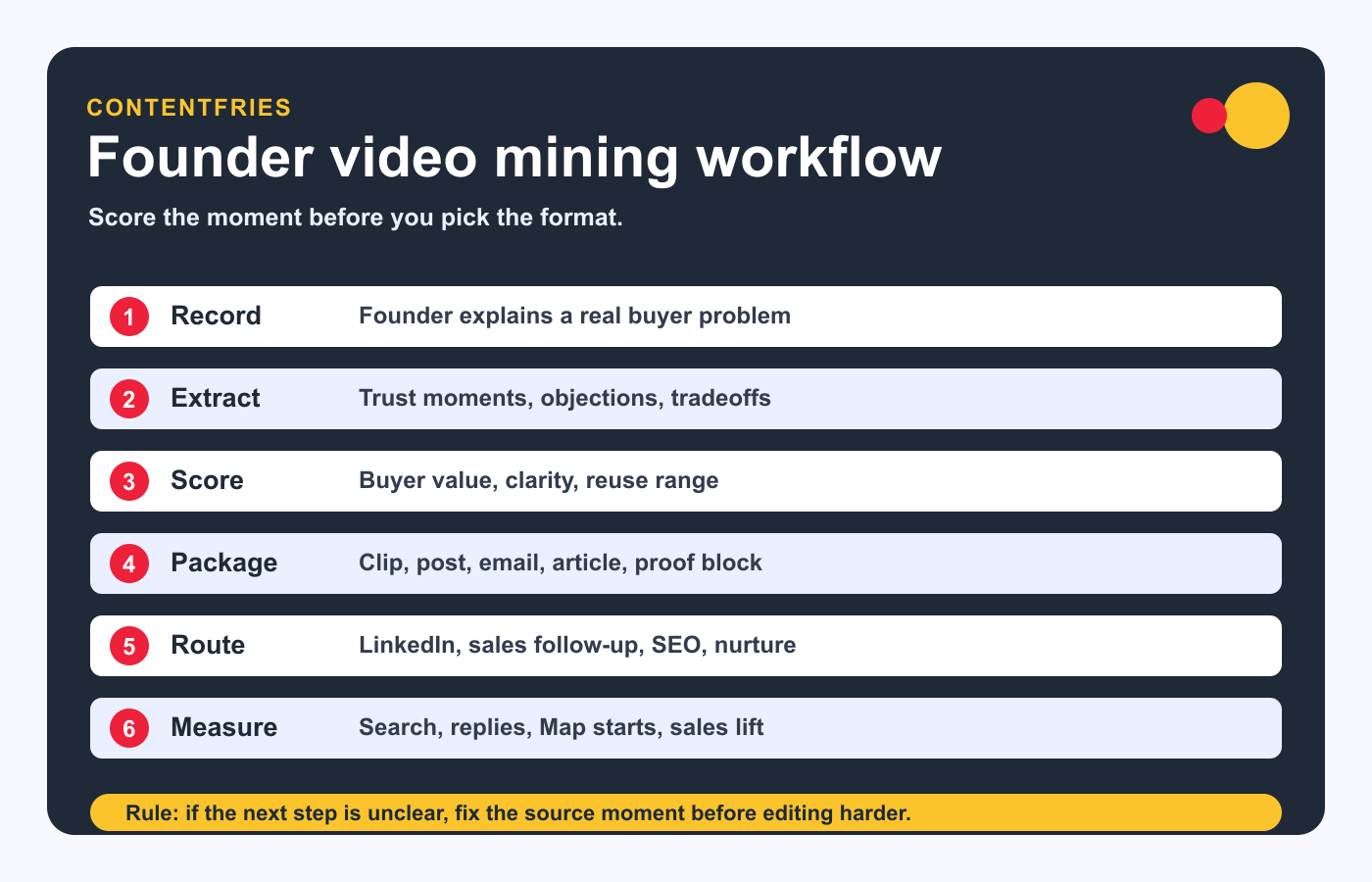
Use one recording first.
Don’t start with a giant content operating system. That’s how teams make a beautiful Notion board and then avoid it.
Pick one founder recording where the thinking is useful and the audience is clear.
Then run this pass.
1. Mark the trust moments
Search for moments where the founder explains a belief, tradeoff, pattern, mistake, or decision.
Good markers:
- “We see this a lot when…”
- “The reason this fails is…”
- “I would not do that if…”
- “The expensive mistake is…”
- “A better way to think about it is…”
- “This only works when…”
- “We built it this way because…”
Those phrases often carry real judgment.
2. Pull buyer language
Founder thinking is useful, but buyer language makes it land.
When the recording includes a question, objection, or messy phrase from a customer or prospect, keep it.
Don’t polish it too early.
“We have 40 podcast episodes and no clue what to clip” is better than “content teams need efficient asset extraction.”
One sounds like a person.
The other sounds like a slide trying to get promoted.
If you do not have buyer language inside the recording, pair the founder moment with language from sales calls, demos, support notes, or comments. The sales calls into content workflow is useful here.
3. Choose the asset lane
Do not make the clip first by default.
Choose the lane that fits the moment:
- short clip for a clear spoken insight,
- LinkedIn post for a founder opinion,
- carousel for a step-by-step framework,
- blog section for a searched question,
- sales email for an objection answer,
- proof block for a before and after,
- product page section for a repeated explanation,
- internal note for sales or onboarding.
The same source can feed several lanes, but each lane needs its own job.
If you turn everything into a clip, you lose a lot of value.
Some ideas are better written.
Some are better shown.
Some are better kept private and sent after a call.
4. Add the missing wrapper
Raw founder clips often need context.
A founder might say something useful halfway through a 40-minute recording, but the clip starts with “and that’s why…” Nobody knows what “that” means. The idea dies in the first second.
Add a wrapper:
- one-line setup,
- on-screen label,
- short intro,
- before state,
- buyer question,
- simple caption,
- related article link,
- next-step CTA.
This is where many teams underinvest.
They edit the clip but forget the doorway.
Then the viewer nods, leaves, and nothing happens.
That is the post-watch gap.
5. Route the asset
Once the moment is packaged, decide where it should go.
Not every founder video belongs on every channel.
Some strong uses:
- LinkedIn post for a clear founder point of view,
- short clip for a high-clarity explanation,
- article section for a durable buyer question,
- nurture email for a stuck lead,
- sales follow-up for a repeated objection,
- product page proof when the moment shows real use,
- internal wiki note when the explanation helps the team.
This is where founder-led content becomes a content engine instead of a posting habit.
One source moment can support awareness, trust, sales, and search.
A Practical Example
Say a founder records a 35-minute walkthrough about how their team chooses which podcast clips to repurpose.
Inside the recording, they say:
“The mistake is choosing clips by energy. The loudest moment is not always the moment that makes a buyer trust you.”
That is a useful line.
Now score it:
- Buyer relevance: 2, because expert-led teams often choose clips by vibe.
- Trust value: 2, because it shows judgment.
- Clarity: 2, because it stands alone.
- Specificity: 2, because “energy” and “buyer trust” make the tradeoff concrete.
- Reuse range: 2, because it can become a clip, post, article section, and sales note.
- Next-step fit: 2, because it naturally points to a Clip Opportunity Map.
That’s a 12.
Now build the stack:
- Short clip: “Stop choosing clips by energy.”
- LinkedIn post: a quick story about high-energy clips versus buyer-useful clips.
- Blog section: how to score podcast moments before editing.
- Sales follow-up: send to a prospect asking why ContentFries does not just cut 20 clips.
- Product page line: “We score moments by buyer value, not just volume.”
- Map CTA: invite the viewer to check what their own archive is hiding.
One founder thought. Six useful assets.
No content calendar cosplay.
What To Avoid
Founder-led content gets weak fast when it chases thought leadership.
Avoid:
- vague lessons with no source moment,
- fake vulnerability,
- “here are 7 lessons from building” without a real point,
- AI-polished paragraphs that remove the founder’s actual phrasing,
- clips that sound clever but help no buyer,
- platform hacks with no business path,
- posting every raw opinion just because the founder said it,
- making the founder sound like a generic B2B account.
The founder voice is the asset.
Don’t sand it down until it becomes brand mush.
Clean it enough to be clear. Keep enough roughness to feel real.
Where AI Helps
AI can help a lot here, but it needs better input than “make clips from this video.”
Better input:
- transcript,
- target buyer,
- offer,
- common objections,
- internal vocabulary,
- examples of good founder phrasing,
- what the content should make a buyer do next.
Then AI can help find moments, group them, score them, suggest formats, draft posts, and build article outlines.
But it should not decide the business value alone.
That judgment still belongs to the operator.
If you want to feed the system better source material, read what to feed an AI content repurposing system. Bad input creates polished mush faster than ever. Good input gives the machine something real to work with.
How ContentFries Fits
ContentFries is built around this source-first idea.
ContentFries is built to find the moments worth repurposing, understand why they matter, and route them into the right content paths.
Extra stuff is easy. Useful paths are harder.
For some recordings, that means clips.
For others, it means posts, emails, article sections, proof blocks, or sales follow-up.
And sometimes it means the recording should stay internal because the useful part is product feedback, not public content.
That is healthy.
If you already have founder videos, webinars, podcasts, demos, or expert recordings sitting around, start with a private Clip Opportunity Map.
It helps you see which moments are worth pulling first, which ones need a wrapper, and where the viewer should go after the watch.
Quick Checklist
Before you publish the next founder clip, ask:
- Who is this for?
- What buyer job does it do?
- What moment in the recording creates trust?
- Is the language specific enough?
- Does it need a wrapper?
- Should this be a clip, post, article section, email, or sales asset?
- Where should the viewer go next?
- Does the asset sound like a real founder, or like generic AI content?
If those answers are clear, you probably have a useful founder-led content asset.
If they are not clear, do not edit harder.
Go back to the source moment.