
Table of contents
Your video archive may already hold your best sales content.
The problem is that most of it is trapped inside long recordings. A webinar has one sharp objection answer. A podcast has one clean founder story. A workshop has one framework buyers need to hear before they trust you.
A video repurposing service should help you find those moments and turn them into useful assets. It should not only cut a long video into short clips.
The Short Answer
A good video repurposing service turns long-form source material into buyer-relevant content. It reviews the full recording, finds the moments that matter, scores them for business use, and then shapes them into clips, posts, articles, emails, or other assets.
If the service only promises “more clips,” be careful.
More output is easy to sell. Useful output is harder. For expert-led companies, the real value is not the number of assets. It is whether the service can spot the ideas, proof, stories, and objections that help the right buyer move closer to trust.
Why This Decision Matters Now
Video is not a side channel anymore. Wyzowl’s 2026 video marketing statistics say 91% of businesses use video as a marketing tool. The same report says 93% of video marketers see video as an important part of their strategy.
That creates a new bottleneck.
Many teams already record useful source material. They host webinars. They publish podcasts. They run demos. They teach workshops. They record customer calls, expert interviews, live streams, founder videos, and sales trainings.
But the recording is only the first asset.
The real business value often sits inside the recording. It is a strong answer, a useful story, a proof point, a buyer objection, or a simple mental model. If nobody maps those moments, the team keeps creating from scratch while the best material sits in the archive.
AI has made this more urgent, not less. The Content Marketing Institute 2026 B2B trends article is based on 1,015 B2B marketers. Its core point is that winning teams are not only using AI to make more content. They are building stronger marketing fundamentals.
That is the right lens for repurposing.
AI can help you move faster. A service can help you produce more. But the system still needs judgment. It needs to know which source moments are worth turning into content and which ones should stay inside the original video.
What A Video Repurposing Service Should Actually Do
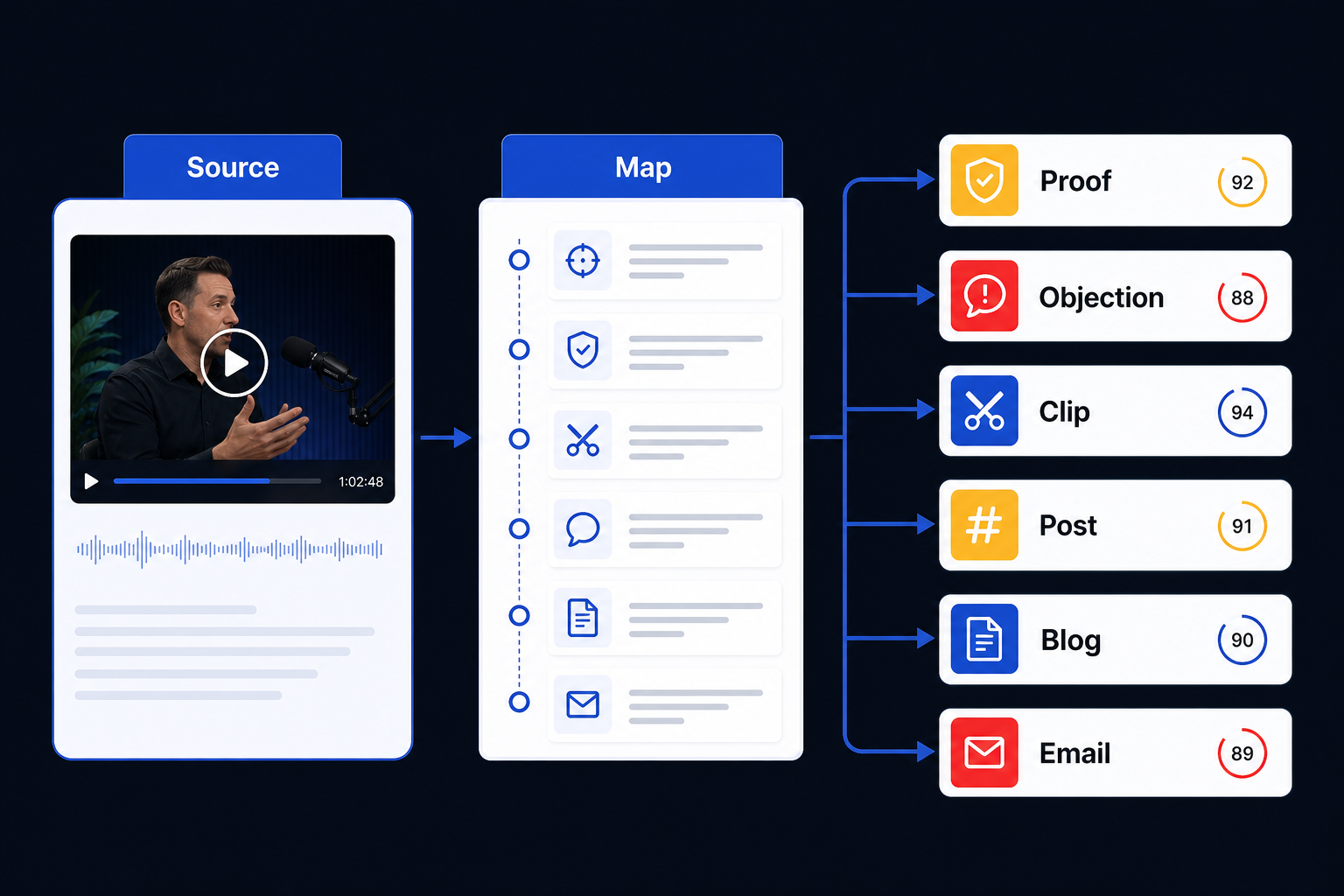
A serious video repurposing service starts before the edit.
It should ask what the source video is meant to do for the business. Is the goal to build trust? Handle sales objections? support a launch? feed LinkedIn? revive old webinars? turn a podcast archive into weekly content? create clips that lead people back to full episodes?
Then it should map the source.
In ContentFries language, that starts with a Clip Opportunity Map. The point is simple: review the long-form video before choosing outputs. Score moments for buyer relevance, proof, clarity, emotion, story, and fit with the offer.
Only then should the service decide what to produce.
A strong service can turn one useful video into:
- Short clips for discovery.
- LinkedIn posts that explain one clear idea.
- Blog sections or full articles from stronger lessons.
- Carousels that make a framework easy to save.
- Emails that help sales or nurture.
- Quote cards, hooks, and channel-specific captions.
- Packaging notes for the original YouTube video, webinar, or podcast.
But not every video deserves every format.
That is where many services get weak. They start with a package like “10 clips, 5 posts, 1 blog.” That can work when the source is strong. It can also turn average material into a bigger pile of average content.
Format should follow the moment. A buyer objection might be best as a LinkedIn post and a sales email. A clear teaching segment might become a blog section. A founder story might become a short clip. A dense framework might become a carousel.
This is why a content repurposing workflow matters. A workflow keeps the service from treating each asset as a separate task. It turns the source video into a small content system.
If you want to test the idea before hiring, start with one strong source recording and run a Clip Opportunity Map. It will show whether the raw material has enough buyer-relevant moments to justify a bigger production plan.
What Real Services Promise
The market already shows that video repurposing is an active category.
Goldcast talks about turning webinars, podcasts, and interviews into social clips, blog posts, follow-up emails, and other assets. Parmonic defines AI video repurposing for B2B teams as turning long-form videos into short clips, written content, and campaign-ready assets.
Managed services use a similar promise, but with more human help.
Spoke asks teams to upload a recording, then builds a creative brief and reviews ideas before creating articles, social content, and newsletters. Komet Media frames its offer around turning podcasts, webinars, and long-form content into short-form videos for LinkedIn, YouTube Shorts, TikTok, and Instagram Reels.
Service comparison pages show the buyer criteria too. DashoContent’s 2026 comparison uses factors like brand governance, turnaround time, pricing model, and production model.
These pages prove the demand is real.
They also prove the phrase “video repurposing service” can mean many things. It can mean an AI tool. It can mean a clip editor. It can mean a managed agency. It can mean a B2B content partner that turns video into clips, posts, articles, emails, and campaign assets.
Before you hire, you need to know which one you are buying.
What To Send Before You Hire
The best service in the world cannot save weak source material forever.
Before you hire, gather a few examples of the source videos you want to repurpose. Do not only send the cleanest one. Send the real pattern. Include a webinar, podcast, demo, sales call, workshop, or YouTube video that looks like your normal content.
Then add business context.
The service should know:
- Who the content should attract.
- What offer or action the content should support.
- Which channels matter.
- Which topics are core to your positioning.
- Which claims need care.
- What your team will review.
- What a good lead or useful conversation looks like.
This does not need to be a huge strategy document. A short brief is enough if it is clear.
Without that context, the service will optimize for surface signals. It may pick the most emotional line, the punchiest hook, or the easiest clip. That may get attention. It may not help the right buyer.
If your team has no source rhythm yet, start smaller. Read how to turn one video into a week of content and test a simple internal loop first.
Also check whether your main source type needs special handling. A webinar repurposing service should look for teaching, proof, and objections. A podcast repurposing service should protect the flow of the conversation while pulling out useful standalone moments.
Service, Editor, AI Tool, Or Internal Team?
Most buyers compare services by price per asset. That is understandable, but it is not the best first question.
The better question is: what is your real bottleneck?
If your team already knows which moments to use, a video editor may be enough. You choose the clips, write the brief, approve the edit, and keep strategy inside the company. That can be lean and effective. The tradeoff is that someone on your side must do the selection work. If you are unsure, compare the decision in content repurposing service vs video editor.
If your team wants speed and can review carefully, an AI tool may be enough. Tools can help with transcripts, summaries, rough clips, captions, social drafts, and blog outlines. They work best when a person still owns judgment.
If your team has strong strategy and production capacity, an internal process may be enough. This fits teams with a marketer who knows the offer, the audience, and the channels. The risk is that internal work often loses to urgent work.
A video repurposing service makes sense when you need both judgment and execution. You need someone to inspect the source material, choose the right moments, produce the assets, and keep the system moving.
A broader content repurposing agency may fit when you need ongoing strategy, writing, editing, design, and distribution support. A focused content repurposing service may fit when you want a map-first sprint before you scale.
The Buyer Fit Test
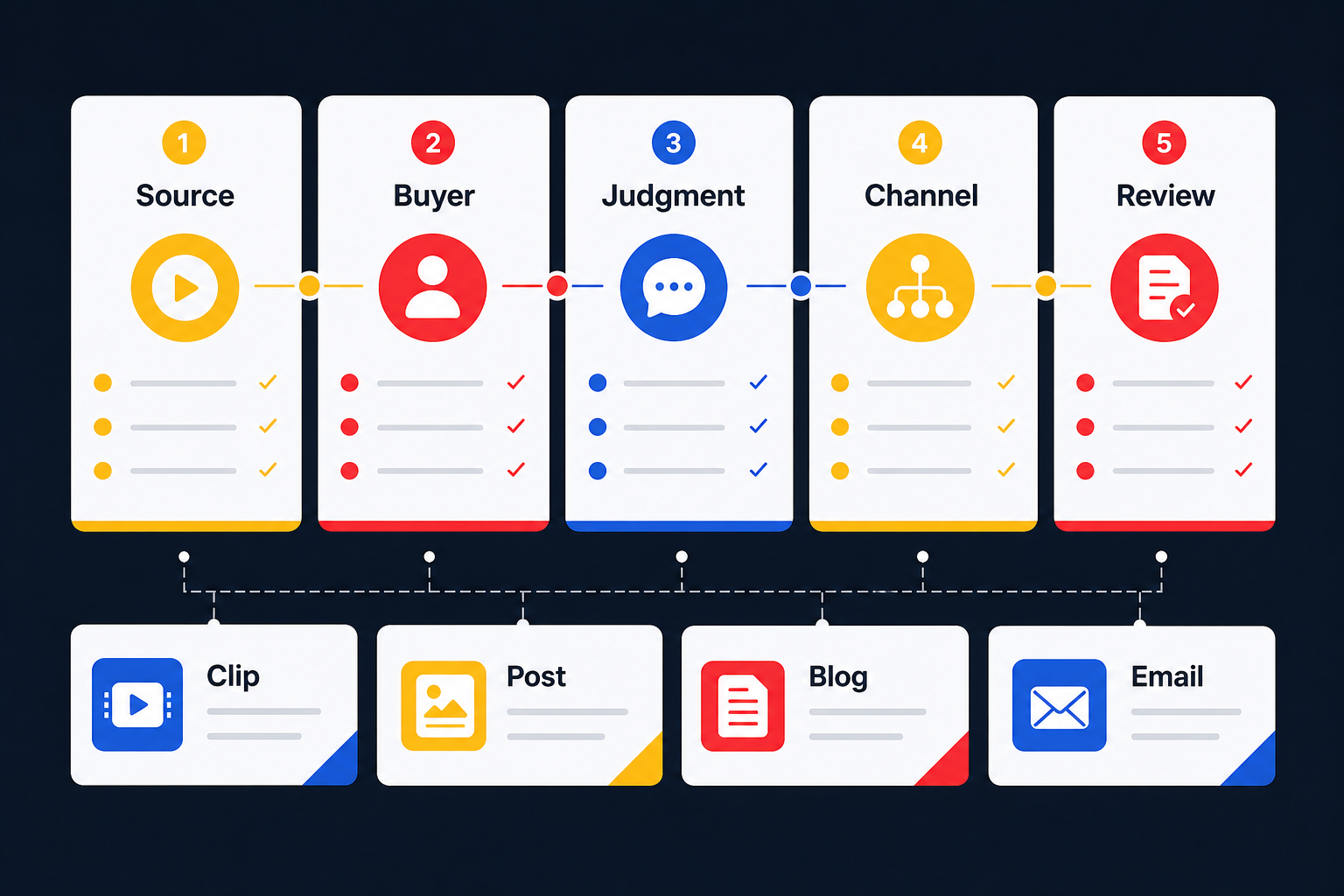
Use this test before you buy a package. Give yourself one point for each yes.
1. Source Quality
Do your videos contain useful thinking?
The best source material has stories, teaching, proof, objections, frameworks, examples, or strong opinions. It does not need studio polish. It does need substance.
2. Buyer Clarity
Do you know who the content is for?
You do not need a perfect persona deck. But you should know the buyer, the offer, and the problem the content should help solve.
3. Selection Judgment
Can the service explain why a moment deserves to travel?
This is the core skill. The answer should include buyer relevance, not only hook strength.
4. Channel Fit
Does the service adapt each asset by channel?
LinkedIn, YouTube Shorts, blog, email, and Instagram do not need the same framing. The same source moment may need a different lead, caption, crop, or CTA.
5. Review Loop
Can your team review fast enough to help the system learn?
Good repurposing improves with feedback. If nobody can approve, reject, or correct the first batch, the service will keep guessing.
If you pass most of this test, hiring can make sense. If you fail most of it, do not rush into a big retainer. Start with a source map or a small sprint.
Your score:
- 0 to 2 points: build a stronger source habit first.
- 3 points: run a small pilot with one or two recordings.
- 4 to 5 points: a video repurposing service is likely worth testing.
Questions To Ask Before You Hire
A good sales call should make the process clearer.
Ask how the service chooses moments. If the answer is only “AI finds the best clips,” ask what the human review adds. If the answer is only “we look for viral hooks,” ask how they handle buyer relevance.
Ask what happens before editing. A strong service should talk about transcripts, source review, creative briefs, content angles, buyer fit, and approvals. It should not only talk about captions and exports.
Ask how it treats different source types. A webinar, podcast, demo, customer interview, keynote, and workshop all need different handling. A good service should explain that difference.
Ask what the outputs are meant to do. Are they for discovery? sales enablement? trust? SEO? launch support? nurturing? thought leadership? If every asset has the same goal, the strategy is probably too shallow.
Ask how revisions work. Repurposing touches voice, claims, context, and taste. A clear review loop matters more than a huge asset count.
Ask how much time your team needs to spend each week. A service should save time after onboarding. It should not create a second production job for your marketer or founder.
Ask what the service will not do. This matters. Some services edit clips but do not write posts. Some write posts but do not publish. Some create blogs but do not handle SEO. Some offer strategy but no distribution. A clear boundary is better than a vague “we do everything.”
Red Flags
The first red flag is volume as the main promise.
“30 assets from one video” can be useful when the source is rich and the selection is strong. It can also become content debt. Your team gets a folder full of assets nobody wants to post.
The second red flag is no buyer context.
If intake is only “send a video link,” the service is acting like a production line. That may be fine for simple editing. It is not enough for business content.
The third red flag is one template for every source.
A founder rant, a webinar lesson, a customer story, a demo, and a podcast interview should not all become the same kind of clip. Templates help production. They should not erase meaning.
The fourth red flag is weak explanation.
If the service cannot explain why it chose a moment, it probably cannot help you build a better system.
The fifth red flag is no path back to the business.
A short clip should not live alone. It should point to a full episode, a useful article, a webinar replay, a sales conversation, a content offer, or a clear next step. Views are not enough.
Where ContentFries Fits
ContentFries is built for map-first repurposing.
The first question is not “How many clips can we cut?” It is “Which moments in this source material can help the right buyer understand, trust, and remember the business?”
That is why the Clip Opportunity Map comes before a bigger production plan. It helps show what is inside your long-form video before you spend money editing the wrong parts.
For good-fit teams, the next step can be a focused Content Sprint. That may include clips, carousels, blog drafts, LinkedIn angles, content calendar direction, and feedback loops. The point is to build a useful content system from real source material.
The fit is strongest when the business already has expert material. A webinar can turn into proof, teaching, and objection-handling assets. A podcast can turn into posts, clips, articles, and sales-support material.
If you are still deciding between internal work and done-for-you help, read do it yourself vs done-for-you content repurposing. The right answer depends on what is missing: strategy, time, taste, production, or consistency.
Start With The Source
Before you hire a video repurposing service, diagnose the source material.
Find the useful moments. Find the proof. Find the objections. Find the stories. Find the parts that should travel outside the original recording.
Then decide who should help you turn those moments into assets.
If you want a simple starting point, use the free Clip Opportunity Map. It can show whether your real bottleneck is source quality, strategy, production, or consistency.
Map first. Edit second.
Sources
- Wyzowl, Video Marketing Statistics 2026
- Content Marketing Institute, B2B Content Marketing Trends 2026
- Goldcast, Content Repurposing
- Parmonic, AI Video Repurposing for B2B Marketing
- Spoke, Content Repurposing Agency
- Komet Media, Short-Form Video Editing Agency
- DashoContent, Best Content Repurposing Services for B2B Marketing Teams in 2026