
Table of contents
Your webinar should not die after launch week.
You already paid for the topic, the prep, the promotion, and the live session. The hard part is done. But for many teams, the replay gets one LinkedIn post, one email, and then it disappears.
That is why a webinar repurposing service exists.
The Short Answer
A webinar repurposing service should find the buyer moments in your recording, score them for relevance, and turn them into a useful content system, not just cut clips. If a service only promises volume and speed, you are probably buying output, not strategy.
Why This Is A Real B2B Problem Now
Webinars are still a serious content source. A 2026 Goldcast webinar benchmark, shared through AMA, says the report analyzed 26,190 webinars across 522 B2B organizations, with 6.8 million registrants and more than 2.2 million attendees.
That is a huge amount of source material. It is also a huge backlog.
Most teams do not struggle to record webinars. They struggle to reuse them well. The recording is long. The best moments are buried. The team is busy. Repurposing becomes “nice to have,” so it slips.
That fits what Content Marketing Institute reported in its 2026 B2B trends research. Effective teams most often point to content relevance and quality, plus team skills and capabilities, as the factors that move results. The same report says the familiar challenge is still making content people want to click, read, or act on. Many teams still struggle with measurement.
So the problem is not only volume. It is judgment.
What A Webinar Repurposing Service Should Actually Do
A good webinar repurposing service starts before editing.
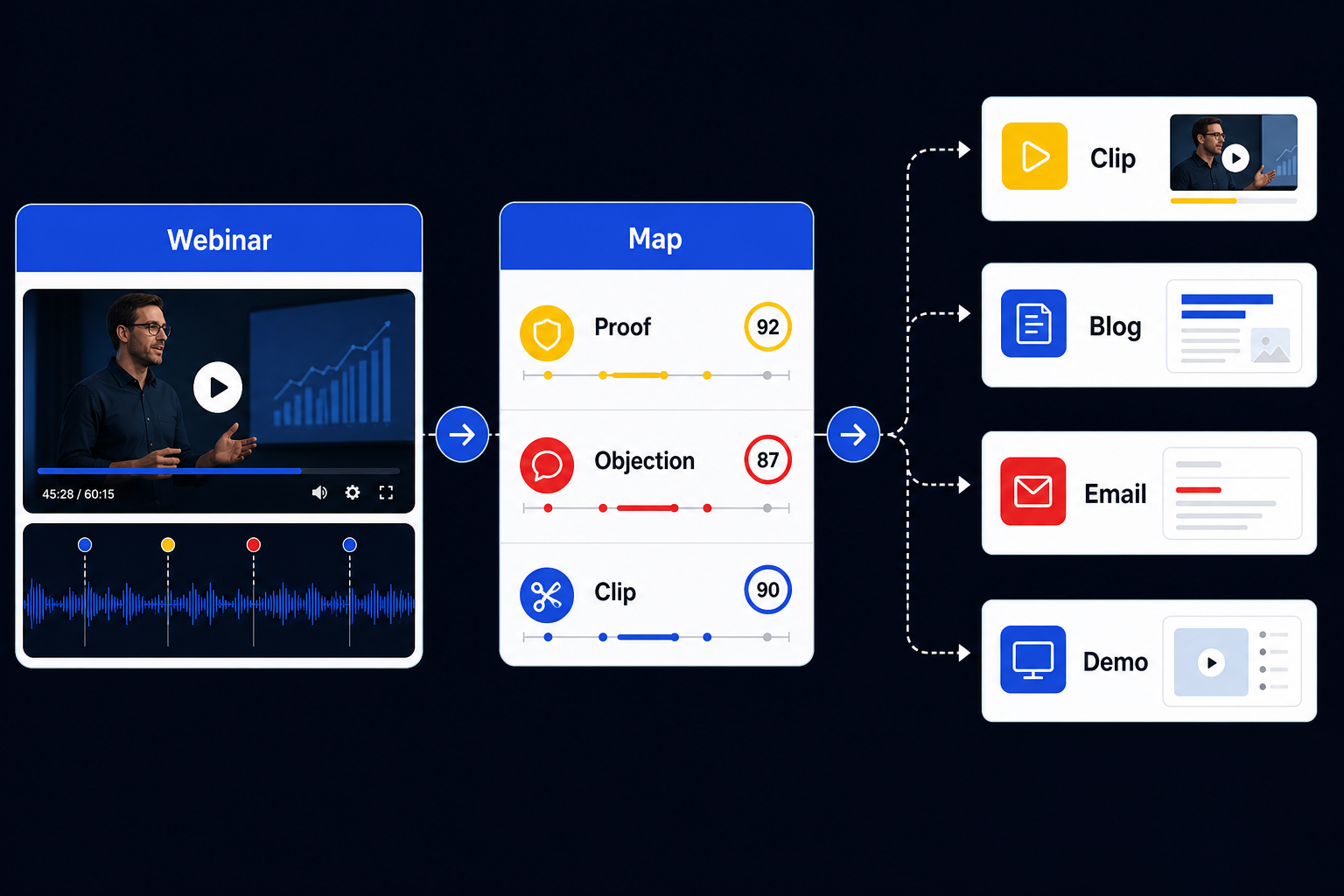
First, it should review the webinar with business context. Who is the buyer? What problem does the webinar help solve? What offer sits behind it? Which parts of the session are useful for awareness, and which parts help someone move closer to a sales call or a demo?
That is the step many teams skip. They go from recording straight to cutting.
The better path is to map the webinar first. In ContentFries terms, that is a Clip Opportunity Map. You score the source material before anyone opens the timeline. You mark the moments that explain the problem clearly, answer objections, show proof, or make the offer easier to understand.
Then the service should turn those moments into a content system.
That can include short clips, yes. But it can also include a summary article, email copy, quote visuals, carousel ideas, short text posts, and follow-up assets that support the long-form recording instead of replacing it.
The format should follow the buyer need. Not the other way around.
What Services Usually Promise, And What Gets Missed
Many service pages lead with asset counts.
You can see that in live service pages. RepurposeOps, for example, publicly frames the offer around one webinar turning into 10 to 20 or more assets, with transcription, drafting, editing, formatting, and a 3 to 5 day turnaround. That pitch makes sense for busy teams. It names the real pain: the webinar is valuable, but nobody has time to repurpose it.
Content 10x takes a more strategy-first angle. Their public FAQ says strategy is where everything starts, webinars and virtual events are common source material, and “checkbox marketing” is not the goal.
Those two public positions show the market clearly. Buyers want two things:
- More output from existing webinars.
- Better judgment about what should be published.
The risk is buying only the first one.
If you get 15 clips from a webinar, but most of them need the full session to make sense, you did not really get 15 assets. You got 15 exports. That is why buyer relevance matters more than clip count.
What To Expect Before You Hire
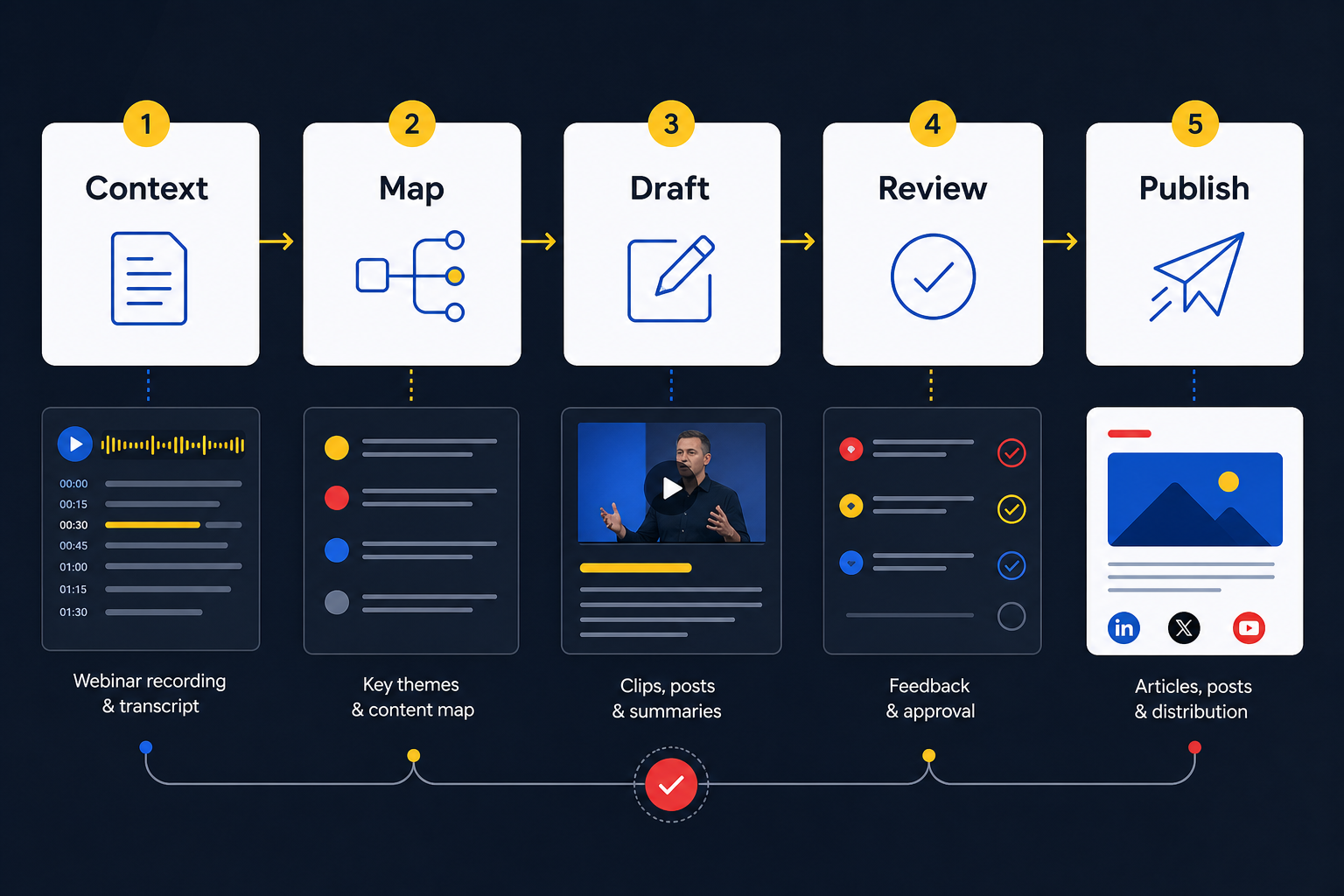
A serious webinar repurposing service should be able to explain its process in plain English.
Onboarding Should Be About More Than The Video File
You should expect questions about your audience, your offer, your sales process, and the role this webinar should play. If the service does not ask who the webinar is for, it cannot judge which moments matter.
The Review Loop Should Focus On Intent
The first review should not be only about trimming seconds or changing colors. It should help you confirm that the right ideas were chosen. Good repurposing starts with message fit, then polish.
Turnaround Should Match The Depth Of Work
Fast turnaround is fine for editing-only work. But if the service claims it will watch, map, write, edit, package, and tailor everything in one day, be skeptical. Some speed is real. Thoughtful judgment still takes time.
Scope Should Be Clear
Before you say yes, you should know:
- which formats are included
- how many assets you get
- whether revisions are included
- whether copywriting is included
- whether publishing support is included
- who owns the final files
If the scope is vague, the result usually is too.
Red Flags
Here are the clearest warning signs.
They Sell Volume As The Main Result
“30 pieces of content” sounds impressive. But a weak webinar can still become 30 weak assets. Volume is not the same as useful output.
They Never Ask About The Buyer
If intake is only “upload file, choose formats, pay invoice,” the service is acting like a clip factory. That may be enough if you already have strong internal strategy. It is not enough if you need help deciding what is worth publishing.
Everything Looks Like The Same Template
A founder webinar, a technical product demo, and a customer education session should not all be repurposed the same way. If every output looks interchangeable, the service is probably formatting content, not thinking about it.
They Jump Straight To Editing
If there is no planning layer before production, you are buying editing help. That can still be useful. It is just not the same thing as strategic repurposing.
When An Internal Team Plus Editor Is Enough
Not every team needs a full service.
If you already know what to pull from each webinar, have a clear editorial point of view, and only need faster production, an editor may be enough. That is especially true if someone on your team can review the full session and flag strong moments quickly.
In that case, it is worth reading content repurposing service vs video editor and do it yourself vs done for you content repurposing. The right answer may be a small internal workflow plus execution support.
You may also be fine with a simpler informational workflow like webinar content repurposing if your main bottleneck is time, not judgment. If your team already has a strong process, the goal may simply be to turn 1 video into a week of content more consistently.
When A Strategic Service Makes More Sense
A webinar repurposing service or B2B webinar repurposing partner makes more sense when your recordings have real business value, but your team cannot consistently unlock it.
That usually looks like this:
- webinars run, then sit unused
- clips get posted, but they feel random
- the best insights stay inside the replay
- one team member becomes the bottleneck for review
- the business needs more than social clips from the same source
If that sounds familiar, you probably need a service that can help build a repeatable content repurposing workflow, not only ship more edits.
A Simple Decision Test
Use these questions before you hire.
- Who finds the best moments?
If your team already does that well, an editor may be enough. If you need outside help finding those moments, you are closer to a service decision.
- What is the real bottleneck?
If the problem is speed, hire for execution. If the problem is judgment and packaging, hire for strategy.
- What outcome do you want?
Better looking clips point to editing help. A better content system points to repurposing help.
- How much strategy do you already have?
Teams with a clear plan need less outside help. Teams with valuable webinars but no repeatable process need more.
If you want a sharper test, score these seven statements:
- We run webinars or similar long recordings at least twice a month.
- The recordings contain useful buyer education, proof, or objection handling.
- Nobody on the team has time to review every webinar properly.
- Our current clips feel disconnected from the rest of our funnel.
- We need assets in more than one format.
- We care more about qualified action than raw views.
- We want one webinar to support a larger content system.
If five or more are true, a strategic service is likely worth testing.
Start With The Diagnosis
Before you hire anyone, find out what your webinar really contains.
Use a Clip Opportunity Map. It helps you spot the strongest moments before you spend time or money on production. That makes it easier to judge whether you need a service, an editor, or a tighter internal process. If you already know you want done-for-you help, compare that diagnosis against the scope on the main content repurposing services page.
If the webinar is strong, the next step can be a service package, a sprint, or your own internal system. If the webinar is weak, no amount of clip volume will save it.
That is the real buying lesson here.
Map before you edit.
Sources
- AMA / Goldcast, 2026 Webinar Benchmark Report Revealed
- Content Marketing Institute, B2B Content and Marketing Trends: Insights for 2026
- RepurposeOps, Webinar Repurposing Service
- Content 10x, FAQ