
Table of contents
Hiring a content repurposing agency sounds simple until you compare the offers.
One agency promises short clips. Another promises LinkedIn posts, carousels, newsletters, blog drafts, and distribution. A tool promises to do it all with AI. A video editor says they can cut the clips for less.
The hard question is not “Who can make more assets?”
The hard question is “Who can find the parts of our source material that are worth turning into assets?”
The Short Answer
A good content repurposing agency should turn long-form source material into a repeatable content system. It should review the original recording. It should find the buyer-relevant moments. It should shape each one for the right channel and help you learn what to make next.
If an agency only sells output volume, you may get more clips and posts. You may not get more trust, more qualified leads, or better sales support.
For expert-led businesses, the best agency is not always the biggest content machine. It is the partner that can explain why a moment matters before it edits that moment.
Why This Hiring Decision Matters Now
Video is now a normal business channel, not a side experiment. Wyzowl’s 2026 video marketing statistics say 91% of businesses use video as a marketing tool. The same report says 82% of marketers say video gives good ROI. It also says 85% use video to generate leads.
That creates pressure on small teams. The CEO records a podcast. The marketing lead runs a webinar. The founder gives a strong workshop. The sales team hears the same objections every week.
All of that can become useful content.
But useful does not mean automatic. A one-hour webinar can become ten weak posts. It can also become one sharp clip and one strong article. It can become a sales follow-up email. It can become a few posts that help the right buyer trust you faster.
That difference comes from judgment.
AI also changed the market. The Content Marketing Institute 2026 B2B content trends report is based on more than 1,000 B2B marketers. It shows AI matters in B2B content work. But the core problem is still strategy, quality, and useful execution.
In other words, faster drafts do not remove the need to choose the right source material.
What A Content Repurposing Agency Should Actually Do
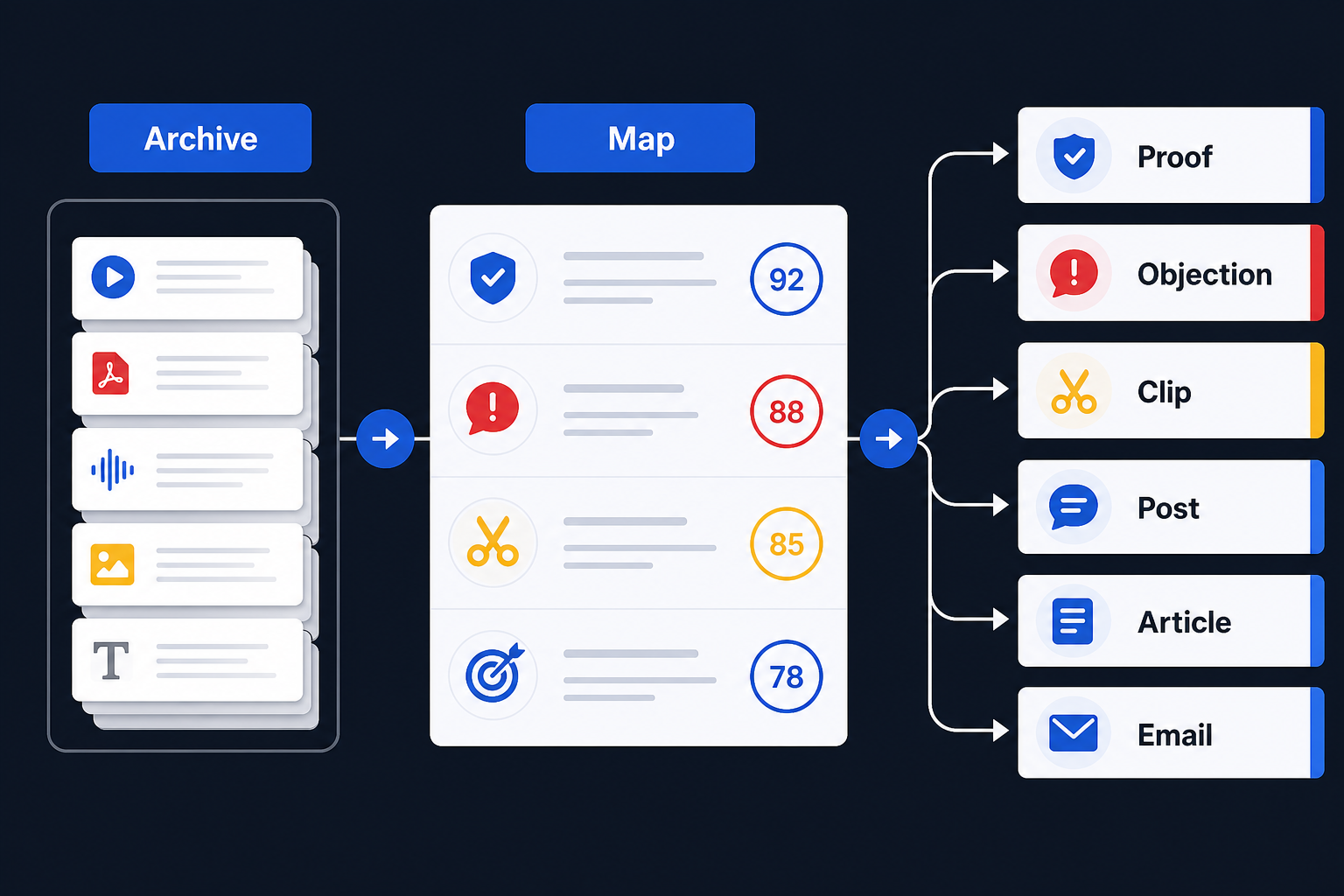
A serious content repurposing agency starts before editing.
It should ask what the source material is meant to do for the business. Is the goal trust? Lead quality? Sales enablement? Founder authority? Better follow-up after calls? More useful posts from content you already made?
Then it should map the source.
In ContentFries language, that starts with a Clip Opportunity Map. The point is to look at the long-form asset before you decide what to produce. You score moments for buyer relevance, proof, objections, and useful frameworks. You also look for strong stories and links back to the full source.
Only then should production start.
A strong agency can help turn one source into:
- short clips for discovery.
- LinkedIn posts that explain one clear idea.
- carousels that turn a framework into a useful asset.
- blog sections or full articles from stronger lessons.
- emails that follow up with prospects or warm leads.
- packaging notes for the original podcast, webinar, or YouTube video.
That does not mean every source should become every format. It means format follows the useful moment.
This is why a content repurposing workflow matters. Without a workflow, repurposing turns into a queue of disconnected tasks. With a workflow, the source becomes a small content system. For a simpler first pass, you can also study how to turn one video into a week of content before you hire anyone.
Agency, Editor, AI Tool, Or Internal Team?
Many buyers compare the wrong options.
They look at price per clip, price per post, or the number of assets in the package. Those details matter. But they do not answer the bigger question: what kind of bottleneck do you have?
A video editor is useful when your team already knows what to cut. If your team can choose the moments and write the brief, a good editor may be enough. Your team still needs to judge the output. The deeper difference is covered in content repurposing service vs video editor.
An AI tool is useful when your team wants speed and can still review the work. Tools can help with transcripts, summaries, rough clips, caption drafts, post drafts, and idea lists. But they still need human judgment around buyer fit and brand meaning.
An internal team is useful when content is close to sales, product, or founder voice. Internal people know the business. The risk is capacity. If every asset waits for one busy founder or marketer, the archive keeps growing.
A content repurposing agency makes sense when the team needs both judgment and execution. It is not only a production vendor. It is a partner that can review source material and choose the strongest ideas. It can produce assets and keep the system moving.
Sometimes the best path is even narrower. A focused Content Sprint can be better than a broad agency retainer. Use it when you first need to prove which source material is worth scaling. A broader content repurposing service makes more sense once that map is clear.
What Real Agencies Promise
The market already proves this is a real service category.
Expound positions itself as a B2B content repurposing agency for marketing teams. Its public site talks about webinars, white papers, video, LinkedIn, social content, and a 90-day system.
Spoke also frames repurposing for B2B. Its public examples include podcasts, webinars, long-form articles, social, newsletters, and sales-funnel content.
Amplify Content Agency sells done-for-you content repurposing from pillar content. Its public offer includes short clips, graphics, written assets, captions, infographics, and carousels.
ZIV focuses on turning long-form video into short-form pieces. Its public offer includes clip strategy, hooks, captions, editing, and posting.
Taken together, these pages show two common shapes. Some agencies sell a broader B2B content system with strategy, writing, and distribution. Others sell a sharper production lane around clips, hooks, captions, and posting.
That is useful evidence of demand, but it also shows why buyers need a clear filter. The same phrase, content repurposing agency, can mean strategy, editing, writing, design, publishing, analytics, or some mix of all of those.
You need to know which one you are buying.
The Buyer Fit Test
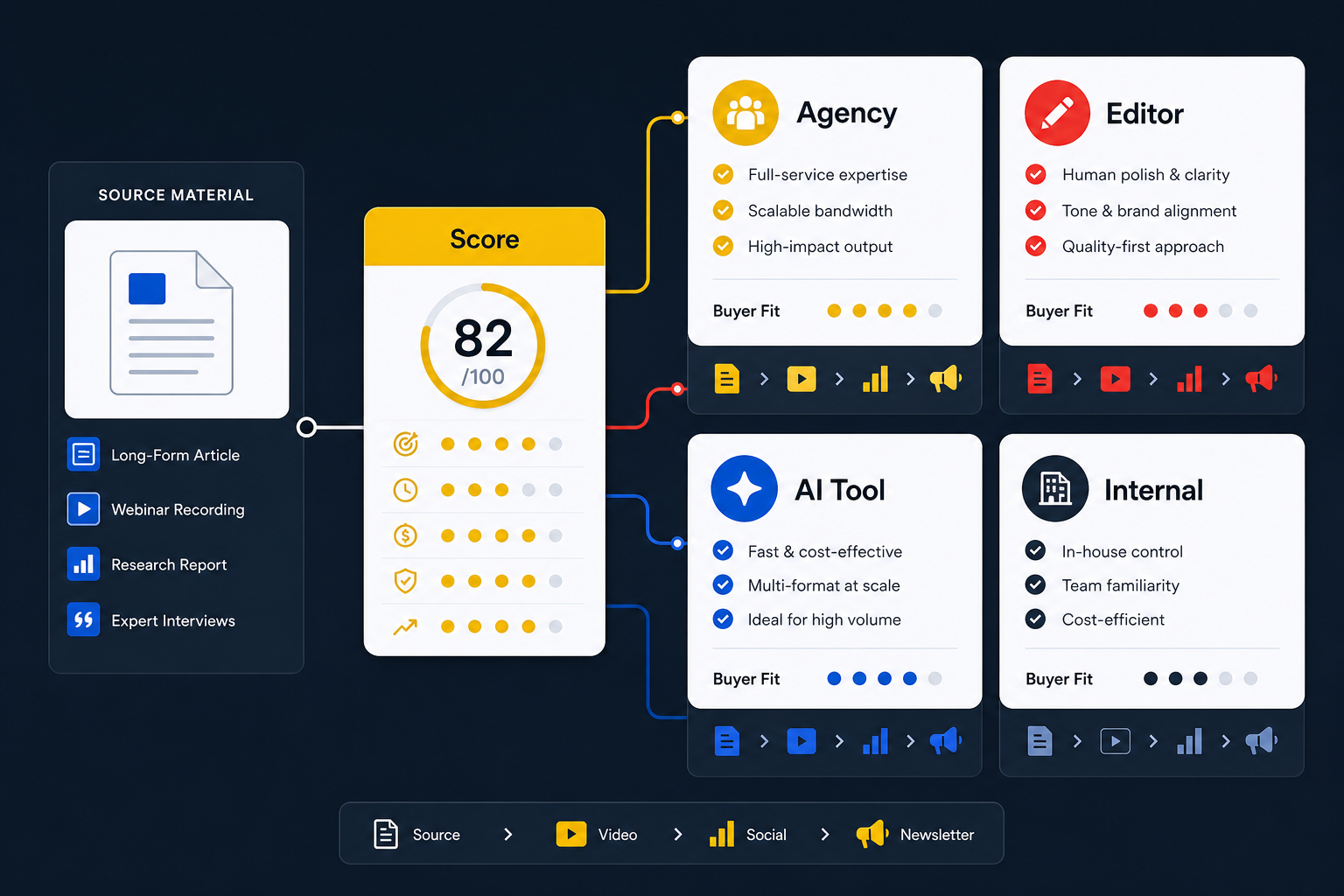
The first condition is source material. Repurposing works best when you already have real thinking inside webinars, podcasts, lessons, demos, workshops, or sales calls. If the source is thin, an agency can only dress up weak material.
The second condition is buyer clarity. You do not need a perfect strategy doc. But you should know who the content should help and which offer it supports. Otherwise, the agency will optimize for the easiest surface: hooks, clips, and output count.
The third condition is approval. Someone on your side must be able to say, “Yes, this sounds like us” or “No, this misses the point.” That review loop keeps the agency aligned.
Use that as the simple scorecard:
- source quality.
- buyer clarity.
- approval loop.
If those three conditions exist, an agency or focused sprint may fit. If they do not, slow down. You may need a clearer offer, a better source material habit, or a simple editor before you buy a bigger service.
Questions To Ask Before You Hire
A good sales call should make the process clearer, not blurrier. You should leave knowing how the agency chooses moments. You should also know what it needs from your team. It should explain how it treats the full source and adapts each asset by channel.
The strongest answer will not be only about hooks, watch time, or viral potential. For a B2B business, the agency should talk about proof, objections, buyer pain, frameworks, and stories. It should know where each asset fits in the sales journey.
It should also define success in business terms. For a founder-led video library, success may include better sales conversations. It may also mean more qualified replies, useful comments, or stronger trust before calls. “More posts shipped” is a production metric. It is not the whole job.
Red Flags
Be careful when the offer is built around asset count first.
“30 assets from one video” can be useful if the source is strong and the selection is smart. It can also create a pile of weak content that your team does not want to publish.
Be careful when every example looks the same. A customer story, solo founder rant, webinar training, podcast interview, and product demo are different source types. They should not all become the same clip template.
Be careful when the agency cannot explain why it chose a moment. If the reason is only “it had a good hook,” that may not be enough.
Be careful when the service ignores the buyer journey. A clip that gets views can still fail. It may attract the wrong people. It may give them nowhere useful to go next.
And be careful with any offer that treats AI as the whole answer. AI can speed up repurposing. It should not replace source-material judgment.
When DIY Or Done-For-You Makes More Sense
There is no moral win in outsourcing too early.
Some teams should start with a simple internal process. Pick one long-form source each week. Mark three buyer-relevant moments. Turn one into a post, one into a clip, and one into an email or article section. Then review what felt useful.
That kind of small loop can teach you a lot.
If your team has strategy but not hands, a normal editor or freelancer may be enough. If your team has hands but no selection system, an agency may help more. If your team has neither, a focused diagnostic is safer than a big retainer.
The broader choice is explained in do it yourself vs done-for-you content repurposing. The right answer depends on what is missing: strategy, time, taste, production, or consistency.
Where ContentFries Fits
ContentFries is built for source-material-first repurposing.
The starting point is not “How many clips can we make?” It is “Which moments in this archive can help the right buyer understand, trust, and remember the business?”
That is why the Clip Opportunity Map comes before a bigger production plan. It helps show what is inside your podcast, webinar, or long-form video. That happens before you spend money editing the wrong parts.
For good-fit teams, the next step is often a focused Content Sprint. It can include clips, carousels, blog drafts, post angles, content calendar direction, and feedback loops. A broader content repurposing service can follow when the team is ready to scale the system.
The best fit is an expert-led business with strong source material. It also has a clear reason to publish. For example, a webinar can become more than a recap. A webinar repurposing service can turn proof, teaching, and objections into assets that support trust. A business podcast can also become more than show notes. A podcast repurposing service can turn one episode into posts, clips, articles, and sales-support material.
That is the real promise of repurposing. Not more noise. More leverage from what you already know.
Start With The Map
Before you hire a content repurposing agency, diagnose the source material.
Find the moments that answer buyer questions. Find the proof. Find the useful stories. Find the parts that deserve to travel outside the original recording.
Then decide who should help you turn those moments into assets.
If you want another set of eyes on the archive, start with a free Clip Opportunity Map. It will help you see whether the real bottleneck is strategy, production, source quality, or consistency.
Map first. Edit second.
Sources
- Wyzowl, Video Marketing Statistics 2026
- Content Marketing Institute, B2B Content Marketing Trends 2026
- Expound, B2B content repurposing agency
- Spoke, B2B content repurposing agency
- Amplify Content Agency, Content repurposing services
- ZIV, Long-form video to short-form content service
- ContentFries, Content Repurposing Services