
Table of contents
You finish a good coaching call.
Or a consulting call. Or a sales call. Or a messy Q&A session where people finally ask the real questions.
Then you close Zoom, maybe drop the recording into a folder, maybe write one follow-up email, and move on.
Fair. You have work to do.
But inside that call there are usually 5-15 moments your future buyers would recognize immediately.
The confused question you answer every week.
The objection nobody says on your landing page, but everyone says on calls.
The example where your framework suddenly clicks.
The tiny story that makes the offer feel safer.
And then the next Monday comes and you ask: “Ok, what should I post?”
It’s a bit crazy when you think about it.
Most expert-led businesses already have source material full of buyer language. They just keep treating it like private admin, not like the raw material for a content system.
Don’t get me wrong. Not every call should become public content. Some things are private. Some moments need consent. Some details should stay between you and the client.
But if you teach, sell, coach, consult, or run workshops, your calls are probably showing you the content market is asking for.
You just need a way to mine the useful bits without turning everything into weird AI sludge.
Why Calls Are Better Than Random Content Ideas
Random content ideas feel productive.
You open a doc. You brainstorm 20 hooks. You ask AI for angles. You look at competitors. You save a few posts. You feel like something is moving.
Sometimes it helps.
But call material has something most brainstorms do not have: real friction.
Someone asked the question because they were stuck. Someone pushed back because the risk felt real. Someone needed an example because the abstract explanation was not enough.
That is useful.
Google’s people-first content guidance asks whether content shows first-hand expertise, adds original value, and helps a real audience achieve its goal. A good call often gives you exactly that raw material: lived objections, actual wording, and specific confusion you can answer from experience.
This is why video repurposing for consultants should not start with “make more clips”. It should start with: what did people already need from you?
If the same question comes up across coaching calls, sales calls, workshops, and onboarding sessions, that question deserves a public answer.
Not because it is trendy.
Because the market keeps handing it back to you.
What Counts As Source Material
You do not need a polished podcast to start.
For expert-led businesses, source material can be very normal:
- a coaching call where one idea finally clicks,
- a sales call where the buyer explains what made them hesitate,
- a group Q&A where 6 people ask versions of the same thing,
- a workshop where you teach the same framework again,
- a customer onboarding call full of setup questions,
- a Loom walkthrough you recorded for one client,
- a support reply that should have been an article months ago.
That last one matters.
Your best content is often hiding in “boring” places because boring to you means repeated. Repeated usually means valuable.
The trick is not to publish private conversations. Please do not do that.
The trick is to extract the pattern.
You remove names, numbers, screenshots, private details, and anything that would make someone feel exposed. Then you keep the useful shape:
“People think they need more content ideas, but the real blocker is deciding which source moments deserve production.”
“A buyer can understand the offer and still hesitate because they do not see the next step after watching.”
“A coach can have strong calls every week and still have weak public proof because none of the real questions become content.”
That is the good stuff.
The Call Moment Has To Earn Its Place
Here is where many teams go sideways.
They record calls, dump transcripts into AI, and ask for 30 posts.
Technically, it works.
Emotionally, it often feels dead.
You get smooth posts with generic lessons. The language is cleaned up until the human tension disappears. The messy sentence that actually sounded like a buyer gets replaced with “unlock your potential” or some other phrase nobody said on the call.
No, thank you.
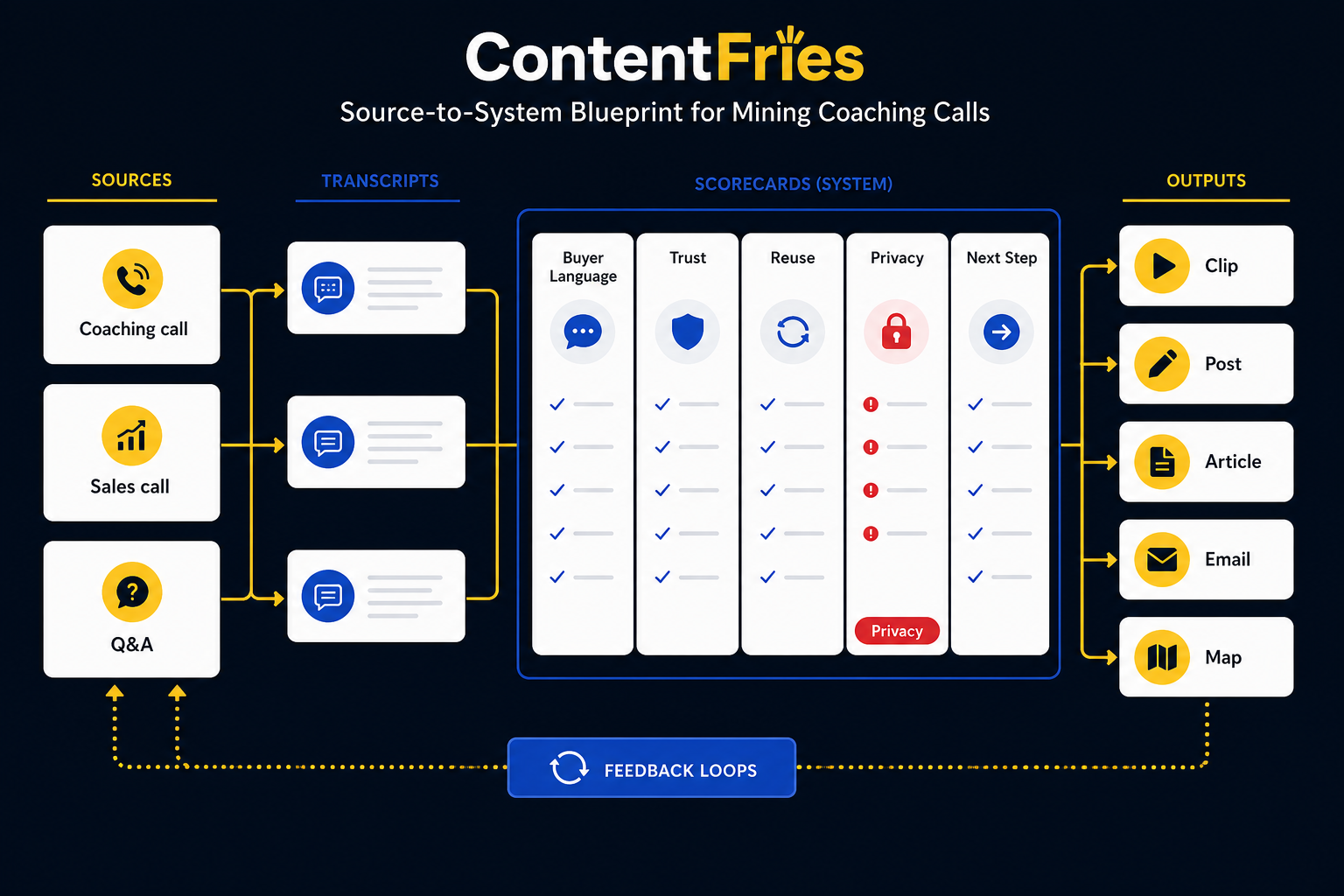
Before you turn a call into content, score the moment.
Use this quick test:
1. Buyer Language
Did the person say something future buyers would also say?
0 means generic.
1 means useful, but broad.
2 means painfully recognizable.
2. Trust Value
Does your answer show taste, judgment, experience, or proof?
0 means it is a throwaway tip.
1 means it teaches something useful.
2 means it makes someone think, “Ok, they get this.”
3. Reuse Potential
Can this one moment become more than one asset?
0 means no.
1 means one post or clip.
2 means it can become a clip, article section, carousel slide, sales enablement point, and follow-up email.
4. Privacy Safety
Can you share the idea without exposing the person?
0 means private. Leave it alone.
1 means possible with careful anonymizing.
2 means it is already a general pattern, no sensitive details needed.
5. Next Step
Does this content naturally point somewhere?
0 means dead end.
1 means it can point to a related article or video.
2 means it clearly routes to a fuller explanation, offer page, workshop, or diagnostic.
Add it up.
8-10: strong source moment. Produce it properly.
5-7: keep it, but improve the angle or context first.
0-4: skip it. Or keep it private.
This is basically the same logic behind what to repurpose first. The source moment gets judged before you spend editing energy on it.
Turn One Call Moment Into A Small Content Stack
Let’s make this practical.
Say someone asks on a consulting call:
“We have 40 webinar recordings. How do we know which ones are worth repurposing first?”
That can become a lot.
You could make:
- a short clip answering the question,
- a LinkedIn post about the hidden cost of treating all webinars equally,
- a blog section explaining source-material scoring,
- a carousel with the 5-point test,
- a follow-up email for prospects with old webinars,
- a sales-call asset that explains why you map before editing.
Same source moment. Different jobs.
The clip creates recognition.
The post gives the idea a sharp public shape.
The article captures search and helps people go deeper.
The carousel makes the framework easy to save.
The follow-up email moves one buyer closer to a decision.
That is a content system.
And it feels very different from “we need 30 posts this month”.
You are not trying to squeeze every call dry. You are looking for moments that already have buyer tension inside them, then giving each moment a useful path.
This matters even more if your content is meant to support a funnel. A good call-derived clip should not end in nowhere. It should close the post-watch gap: after someone watches, reads, or nods along, they should have a sane next step.
Maybe that next step is a full article.
Maybe it is a webinar replay.
Maybe it is a service page.
Maybe it is your free Clip Opportunity Map, where ContentFries looks at your source material and shows what is worth repurposing first.
The point is: the moment should not die after the view.
Be Careful With Consent And Context
Quick boring-but-important part.
If you use call material, do it like a decent human.
Do not publish private client details.
Do not use someone’s story in a way that makes them identifiable unless you have clear permission.
Do not quote sensitive language from sales calls to make yourself look smart.
Do not pretend a private client win is public proof if the client has not agreed to it.
You can still use the learning.
Turn exact details into patterns. Turn private examples into generalized lessons. Turn repeated objections into public education. Turn a real question into a safer version that protects the person.
This also protects the content.
When you keep context, your answer sounds specific. When you strip the wrong details, it sounds generic. Good repurposing keeps the buyer tension and removes the private identifiers.
Tiny difference.
Big effect.
AI Can Help, But It Should Not Be The Strategist
AI is useful here.
Very useful.
It can transcribe. Cluster questions. Pull repeated objections. Summarize sections. Draft posts. Turn one answer into 5 formats. Create first-pass outlines. Compare call moments.
But AI should not decide what matters alone.
Research on tools like PodReels points to the real pain: selecting interesting moments from long recordings takes mental effort, and editing them into coherent teasers takes time. AI can reduce the grind, but the business judgment still matters.
For an expert-led business, the best content is rarely the loudest moment.
It is the moment with buyer relevance.
The moment that explains the risk.
The moment that shows your taste.
The moment that makes a sales conversation easier next week.
So use AI for speed.
Use your judgment for selection.
That is why a video content repurposing strategy should come before production. Otherwise you just make more assets from weak moments, faster.
Congratulations, you automated waste.
A Simple Weekly Call-Mining Workflow
You do not need a huge system.
Start with one weekly pass.
- Pick 2-3 calls, workshops, or Q&A sessions from the week.
- Pull the transcript or notes.
- Mark every real question, objection, story, example, and “aha” moment.
- Score each moment with the 5-part test above.
- Pick the top 1-3 moments.
- Decide the best format for each one: clip, post, article section, carousel, email, or sales asset.
- Add a next step before you publish.
That is enough.
Do it for 4 weeks and you will see patterns.
The same objection keeps coming back.
The same example keeps working.
The same type of clip warms people up.
The same article idea keeps appearing in different words.
Now you are not guessing anymore. You are listening to your own market and building from source material.
If you want help with this, ContentFries can map it for you.
The free Clip Opportunity Map looks at your long-form source material and shows which moments deserve repurposing first, why they matter, and where they could send people next.
And if you want the done-for-you version, the content repurposing service is for expert-led businesses that want the system built around their source material, not just more random clips.