
Table of contents
You finally get a good customer call.
The kind where someone explains what was happening before they found you. The messy buying process. The hesitation. The “I almost did nothing” part. The tiny moment where your offer started to make sense.
Then the call ends.
Maybe someone says, “Great, we should turn this into a case study.”
And then… nothing.
The recording sits in a folder. The transcript gets ignored. The best buyer language gets buried under project work, Slack messages, client delivery, and the next urgent thing.
Fair. You have work to do.
But this is expensive.
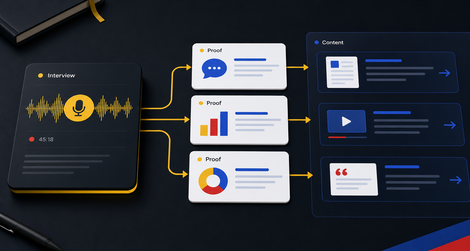
Because one honest customer interview can give you proof for a landing page, objections for sales content, clips for social, examples for articles, email angles, and better language for your offer.
Not from a brainstorm.
From a real person explaining why they cared.
Don’t get me wrong. Customer interviews are not free content confetti. Some details stay private. Some claims need permission. Some stories need to be anonymized hard. Some should never become public at all.
But if you are already talking with customers, and your content still sounds like you invented every objection in a quiet room, something is leaking.
You do not need more random post ideas first.
You need to stop losing the proof you already earned.
Why Customer Interviews Beat Another Brainstorm
Brainstorms are useful.
Sometimes.
But they have one obvious weakness: you are still inside your own head.
You write what you think buyers care about. You guess which objection matters. You polish your framework until it sounds clear to you, because you already know it.
Customer interviews pull you back to earth.
Someone says the clumsy version of the problem. Someone explains what almost stopped them. Someone compares you to the wrong alternative. Someone tells you which part of the result actually mattered after the work was done.
That is gold.
Google’s people-first content guidance talks about first-hand expertise, original value, and content that helps an existing audience achieve its goal. A strong customer interview gives you all three if you handle it well. You are not just summarizing the SERP. You are answering real buyer friction from real conversations.
This is also why video content repurposing strategy should not begin with output formats.
“Let’s make 12 clips” is not a strategy.
“This customer described the exact hesitation our next buyer has, and we can answer it with proof” is much closer.
What You Can Pull From A Customer Interview
You are not looking for one giant testimonial.
That is the trap.
Most teams hear “customer interview” and think the output has to be a polished case study. Big headline. Company logo. Before and after. Three approved quotes. Legal review. Everything shiny.
Nice when you can get it.
But the smaller pieces are often more useful day to day.
From one customer interview, you can pull:
- the words they used before they knew your category,
- the trigger that made them start looking,
- the alternatives they considered,
- the objection that nearly killed the deal,
- the proof point that made them feel safe,
- the setup mistake they made before getting help,
- the moment where your process finally clicked,
- the result they actually cared about after delivery.
Each of those can become content.
Some become public clips. Some become an article section. Some become a sales email. Some become better FAQ copy. Some stay internal and help your team explain the offer without sounding like a brochure.
That last part matters.
You do not have to publish every useful thing.
Sometimes the highest-value content asset from a customer interview is a sharper sales page section or a better reply to the objection your next buyer will send on Thursday afternoon.
Score The Proof Before You Publish It
Here is where people make a mess.
They record a good customer interview, drop the transcript into AI, and ask for posts.
Technically, it works.
Emotionally, it often feels fake.
You get smooth content with the danger removed. The customer sounds like a brand deck. The interesting hesitation gets cleaned into “we needed a scalable solution.” The specific result becomes “improved efficiency.”
Congratulations, you turned proof into soup.
Before you publish anything, score the moment.
Use this quick test:
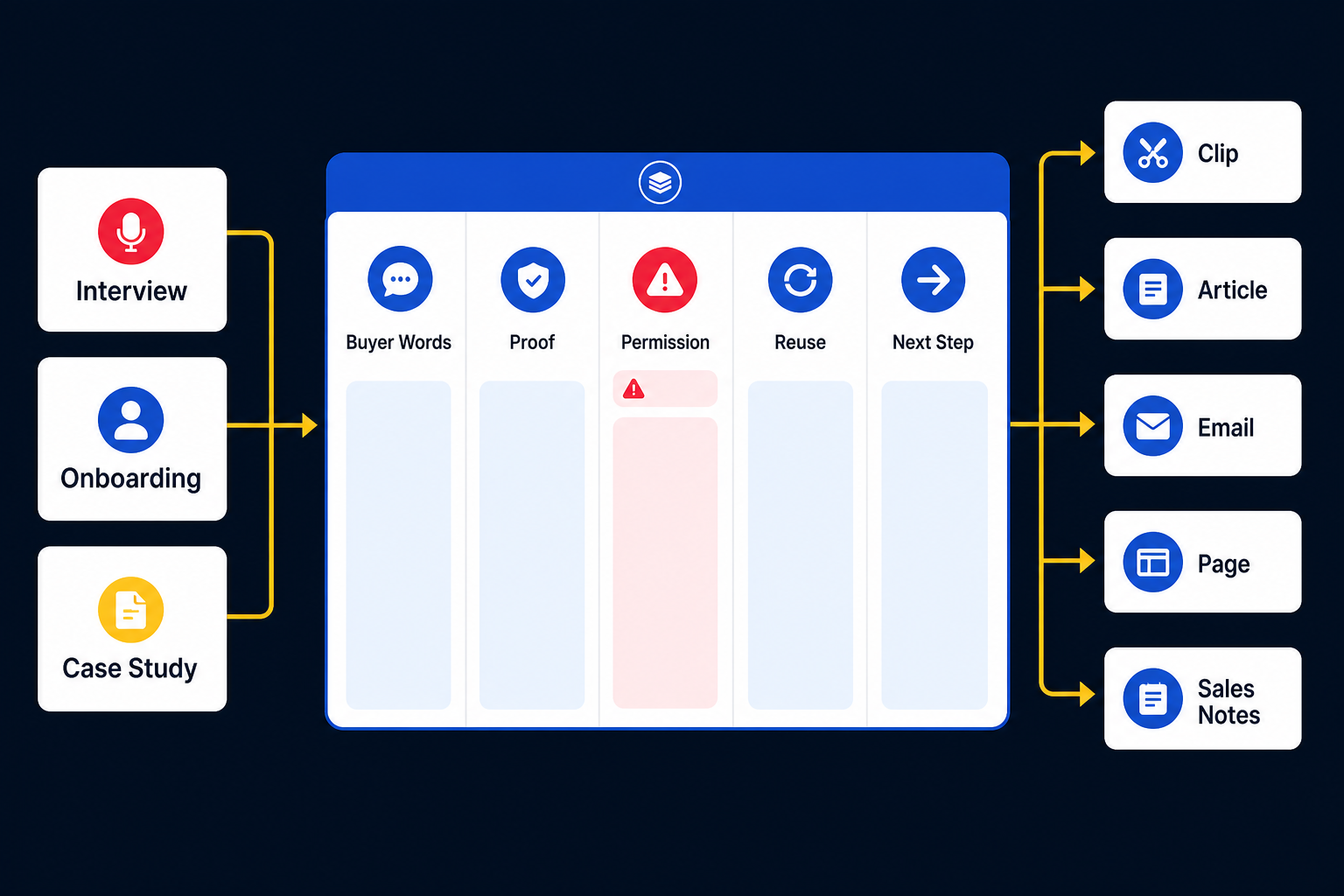
1. Buyer Language
Did the customer say something future buyers would recognize?
0 means generic.
1 means useful, but broad.
2 means painfully recognizable.
2. Proof Value
Does the moment show a concrete change, decision, result, or shift in thinking?
0 means nice words.
1 means usable support.
2 means real proof that lowers risk for the next buyer.
3. Permission Safety
Can you use this without making the customer feel exposed?
0 means private. Leave it alone.
1 means possible with anonymizing or approval.
2 means already safe, approved, or general enough.
4. Reuse Potential
Can the same moment support more than one asset?
0 means no.
1 means one post, email, or clip.
2 means it can become a clip, article section, landing page proof block, sales enablement note, and follow-up email.
5. Next Step
Does this content naturally point somewhere?
0 means dead end.
1 means it teaches, but does not route.
2 means it clearly leads to a page, offer, Clip Opportunity Map, call, or next content step.
If a moment scores high on buyer language, proof value, permission safety, reuse potential, and next step, it deserves attention.
If it scores low, keep it in the notes.
No shame.
Not every honest customer sentence needs to become a LinkedIn post. Please spare us all.
One Interview Can Become A Small Proof System
Think smaller than a campaign.
One customer interview can become a proof system if you split it by job.
Example shape:
- Short clip: the customer explains the before-state or the moment they knew they needed help.
- Article section: you unpack the broader pattern without exposing private details.
- Sales email: you answer the objection that came up before the customer bought.
- Landing page proof block: you use the approved result or anonymized pattern near the relevant CTA.
- Internal sales note: you save the exact buyer language so future calls sound less theoretical.
Now one interview is not “content”.
It is a little proof engine.
This is where what to repurpose first becomes practical. You are not choosing the loudest moment. You are choosing the moment that can warm up the right buyer before they ever talk to you.
That also helps fix the post-watch gap. A clip that tells a nice story but sends people nowhere is still weak. A clip that answers a real hesitation and points to the next step can do actual business work.
Very different game.
Consent Is Part Of The Content System
This is the boring section.
Also the section that keeps you from doing something weird.
Customer interviews involve trust. If someone shared numbers, team problems, buying fears, internal politics, or mistakes, that does not automatically become public material because the recording exists.
You need a simple permission habit.
Before using customer material publicly, decide:
- is the customer named or anonymized?
- is the claim approved?
- is the quote exact or paraphrased?
- is there a material relationship or incentive that needs disclosure?
- would the customer feel surprised if they saw this post?
The FTC’s endorsement guidance is a useful reminder here: customer endorsements and testimonials need to be truthful, not misleading, and disclosed properly when relationships or incentives matter.
Plain English version:
Do not make the customer sound like they promised something they did not promise.
Do not hide a paid or connected relationship if that relationship changes how a reader would understand the claim.
Do not turn private context into public drama because it makes a better hook.
You can still use the pattern.
You can say, “A customer recently described this hesitation…” and remove the details.
You can say, “This comes up in customer interviews a lot…” and teach the lesson.
You can ask for a specific approved quote and use only that.
You can keep the best note internal.
That is not being timid. That is respecting the source.
Where This Goes Wrong
There are a few common ways teams ruin this.
First, they over-polish.
The real sentence was: “I knew we needed help because every launch turned into a messy folder of half-used clips.”
The published version becomes: “We needed a scalable content operations partner.”
No.
Keep the real texture when you can. That texture is why the next buyer believes it.
Second, they chase the most flattering quote.
Nice praise feels good. It rarely carries the whole content system.
The better moment is often the hesitation before the praise. The risk. The alternative. The part where the customer almost stayed stuck.
That is where future buyers recognize themselves.
Third, they create proof with no route.
The clip gets views. The post gets likes. The quote graphic looks nice. Then nothing happens.
If the moment is about content waste, route people to a Clip Opportunity Map. If the moment is about needing help turning interviews and long-form source material into usable assets, route them to content repurposing services. If the moment is about call mining, route them to turning coaching calls into content.
Reader paths beat link dumps.
Build A Customer Proof Map Before Editing
Before you edit clips, write posts, or ask AI for 30 assets, make a small map.
For each interview, capture:
- the customer type,
- the before-state,
- the trigger,
- the objection,
- the turning point,
- the proof point,
- the approved quote or anonymized pattern,
- the best next step for a similar buyer.
Then choose the moments worth producing.
This is exactly the type of thinking behind the ContentFries Clip Opportunity Map.
It looks at source material and asks: what is actually worth turning into content, why does it matter, and where should the viewer or reader go next?
Yummy side-effect: your case studies, sales pages, and emails get better too, because the same proof map feeds all of them.
If you already have customer interviews sitting around, start with one.
Do not make a huge system.
Pick one customer conversation. Score five moments. Choose one that is safe, specific, and useful. Turn it into one public asset and one sales asset.
Then repeat.
That is how customer interviews stop being a folder of nice calls and start becoming proof your next buyer can actually feel.